Orlando landmarks
Photo: Familydestinationsguide.com Images · CC BY 2.0

Landmarks

Orlando's Most Iconic Landmarks

A deep guide to Orlando's iconic landmarks: Cinderella Castle, Spaceship Earth, and The Wheel at ICON Park, with history and insider visiting tips.

Orlando wears its ambitions in fiberglass, steel, and shimmering water.

This is the city that transformed cattle pasture and citrus groves into the busiest theme park destination on earth, gave the world a castle that turned a swamp into a stage for imagination, and wrapped a geodesic sphere around the story of human communication.

To move through greater Orlando is to travel across scales of wonder, where a Gilded Age Tiffany window glows in a quiet museum in Winter Park while, half an hour east, real rockets stand ready on the launch pads of the Space Coast.

What makes Orlando's landmarks so compelling is that they are not only the manufactured icons of its resorts.

They gather around Lake Eola downtown, spread along the neon corridor of International Drive, and reach out toward Merritt Island in a way that lets you read the region's story chapter by chapter, from frontier attraction to space frontier.

The theme parks argue with one another across the tourist districts, the public gardens invite you to slow down, and the museums hold collections that draw scholars as readily as families.

The lakes, hundreds of them scattered through the metro, tie it all together and give the city its soft, subtropical light.

This guide gathers eleven landmarks that define Orlando: the record-setting attractions, the beloved works of public space, the world-class collections, and the launch complex that changed how humanity reaches beyond the planet.

For each you will find what it is, why it matters, what to look for, and how to visit sensibly. Read it front to back for a narrative of the city's imagination, or skip to the places that call to you and build your own route from the lakefront to the parks to the coast.

Landmark · Bay Lake / Walt Disney World · 1971

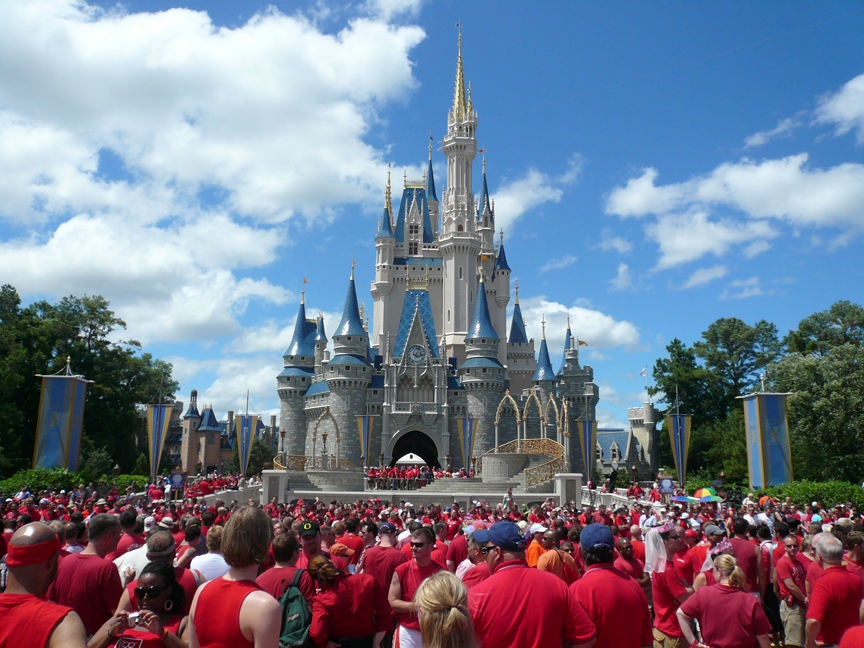
Cinderella Castle (Magic Kingdom)

The soaring blue-and-gold spire at the center of the Magic Kingdom, the image that launched a thousand childhood dreams.

Cinderella Castle stands at the heart of the Magic Kingdom, the theme park that opened the vast Walt Disney World resort southwest of Orlando in 1971. Rising to roughly 189 feet, it is the visual anchor of the entire property, framed at the end of Main Street, U.S.A.

and drawing every visitor forward toward the hub from which the lands of the park radiate.

The design blends elements of European fairy-tale architecture, including the medieval turrets and slate-blue rooflines evocative of French chateaux and Bavarian castles such as Neuschwanstein.

Its designers used a technique called forced perspective, making the upper stones, windows, and spires progressively smaller so the structure reads as far taller and more distant than it truly is.

Unlike a stone building, it is built around a steel framework clad in fiberglass, engineered to withstand the hurricanes that sweep central Florida.

Inside sits the small, exclusive Cinderella Castle Suite, and the walk-through breezeway is lined with hand-cut glass mosaic murals telling the Cinderella story.

By day the castle is a photographer's magnet, and after dark it becomes a canvas for projection shows and fireworks that erupt behind and above its spires, a nightly spectacle that draws crowds to the hub well before showtime.

Visiting

Cinderella Castle sits inside the Magic Kingdom, which requires a dated park ticket and, at busy times, a reservation, so plan and book well ahead. The castle courtyard and breezeway are free to walk through once inside, and the best unobstructed photographs come first thing at opening or during a parade, when the central hub thins out. Stake out a spot on the hub lawns thirty to forty minutes before the evening fireworks for the classic castle-and-sky view. Allow a full day for the park itself.

Insider tip: For the cleanest castle photo without crowds, arrive at rope drop and head straight up Main Street: the first fifteen minutes after opening give you the near-empty esplanade that is impossible to get later in the day.

📍 View on Google Maps →

Landmark · Universal Orlando Resort · 2010

Hogwarts Castle (The Wizarding World of Harry Potter)

A brooding, mist-wreathed castle of towers and turrets that made the world of Harry Potter feel astonishingly real.

Hogwarts Castle crowns The Wizarding World of Harry Potter at Universal's Islands of Adventure, the immersive land that opened in 2010 and reshaped what a theme park environment could be.

Perched above the cobbled village of Hogsmeade, the castle presents the craggy silhouette of towers, battlements, and turrets familiar from the films, its stone facade weathered to look centuries old.

The castle is not merely scenery: it houses Harry Potter and the Forbidden Journey, a ride that winds guests through the portrait-lined corridors, Dumbledore's office, the Defense Against the Dark Arts classroom, and the greenhouses before launching them on a flight through the world of the story.

The queue itself is a walkthrough attraction, and the attention to detail, from the talking portraits to the Sorting Hat, rewards a slow pass rather than a rush to the ride.

Below the castle, Hogsmeade delivers the rest of the illusion: the crooked chimneys, the snow-capped rooftops that stay white in the Florida heat, the shops selling wands and Butterbeer, and the scarlet Hogwarts Express that connects this land to Diagon Alley in the neighboring park.

On select evenings, a projection and light show plays across the castle walls, and the whole village is designed to make the leap from screen to street feel seamless.

Visiting

Hogwarts Castle lies within Islands of Adventure, so admission requires a Universal Orlando park ticket, and the connected Diagon Alley in Universal Studios Florida is best experienced with a park-to-park ticket to ride the Hogwarts Express between them. Crowds build quickly, so arrive at opening and consider Universal's paid Express Pass on busy days. Evenings bring cooler temperatures and, on some dates, the castle light show. Budget most of a day to do both Wizarding World areas justice.

Insider tip: Ride Forbidden Journey first thing, then return to walk the queue slowly later: at opening you can move through the castle interior quickly, but a second, unhurried pass lets you actually take in the greenhouses and the portraits you sped past.

📍 View on Google Maps →

Landmark · Bay Lake / Walt Disney World · 1982

Spaceship Earth (EPCOT)

A gleaming geodesic sphere the size of a small moon, the unmistakable icon of Disney's park of tomorrow.

Spaceship Earth is the enormous silver geodesic sphere that greets every guest entering EPCOT, the Walt Disney World park that opened in 1982 with a mission to celebrate human progress and world cultures.

Standing about 180 feet tall and 165 feet in diameter, it is a complete sphere rather than a dome, supported on legs and clad in thousands of triangular aluminum panels that shimmer in the Florida sun.

The name and the geodesic form owe a debt to the inventor and thinker Buckminster Fuller, who popularized both the geodesic structure and the phrase Spaceship Earth as a way of describing the planet as a single shared vessel.

Rain that falls on the sphere is channeled through its outer skin and collected rather than cascading onto guests below, one of many quiet engineering touches hidden in plain sight.

Inside, a slow-moving dark ride carries visitors up through the interior of the sphere on a journey through the history of human communication, from cave paintings and the invention of writing to the printing press and the digital age.

The gentle pace and detailed scenes make it a beloved fixture, and emerging back into daylight beneath the vast curved shell is a small thrill in itself.

The sphere anchors the park's forward-looking World Celebration and remains one of the most recognizable structures in all of Florida.

Visiting

Spaceship Earth sits just inside the main entrance of EPCOT, which requires a dated park ticket and, at peak times, a reservation. The ride inside is one of the park's most reliably low-wait attractions and is fully enclosed and air-conditioned, making it a welcome refuge on hot afternoons. The exterior is at its most striking photographed at dusk, when the panels catch the last light and the sphere is illuminated from below. Plan a full day for EPCOT's many pavilions.

Insider tip: Save Spaceship Earth for the middle of a hot day: while the thrill rides build long lines, this air-conditioned classic usually stays a short wait, giving you a cool, relaxing break exactly when you need one.

📍 View on Google Maps →

Landmark · International Drive · 2015

The Wheel at ICON Park

A 400-foot observation wheel over the neon spine of International Drive, turning slow circles above the theme-park capital.

The Wheel at ICON Park is the towering observation wheel that dominates the skyline of International Drive, Orlando's dense corridor of hotels, restaurants, and attractions.

Standing 400 feet tall and opened in 2015, originally as the Orlando Eye, it rotates on a spoked frame studded with LED lighting that puts on a color show after dark, visible for miles across the flat central Florida landscape.

Riders board fully enclosed, air-conditioned glass capsules that make a slow, smooth revolution over roughly twenty minutes, a welcome comfort in the summer heat.

From the top, the view stretches across the sprawl of Orlando toward the distant theme parks, and on clear nights the fireworks bursting over Disney and Universal can be spotted glimmering on the horizon.

The wheel is the centerpiece of ICON Park, an open-air entertainment complex packed with restaurants, a wax museum, an aquarium, thrill rides, and an ever-changing lineup of attractions along the pedestrian promenade.

Unlike the ticketed theme parks, the park grounds are free to wander, so many visitors come simply to stroll, eat, and take in the lights before or after a ride to the top.

Visiting

The Wheel operates daily into the evening, and timed tickets bought in advance often come cheaper than the gate price, so check for online deals and combination passes with the neighboring aquarium and wax museum. The surrounding ICON Park promenade is free to enter, with paid parking and easy access from International Drive. Ride near sunset to catch both the daytime panorama and the city lights coming on, and expect a full rotation of about twenty minutes. Evenings are livelier but busier than afternoons.

Insider tip: Book a capsule for the golden hour just before sunset: you begin your rotation in daylight over the theme-park sprawl and finish it as the LED lights ignite and the strip below flares into neon, two views for one ticket.

📍 View on Google Maps →

Park · Downtown Orlando · 1883

Lake Eola Park

Downtown's green heart, a mirror lake ringed by a walking path and crowned by a fountain that glows against the skyline.

Lake Eola Park is the leafy centerpiece of downtown Orlando, a public green space wrapped around a spring-fed lake that has served as the city's front yard since the 1880s.

A paved path just under a mile loops the shoreline, drawing joggers, dog walkers, and strollers, while the surrounding lawns, gardens, and towering cypress and oak trees offer shade in a district otherwise crowded with towers.

At the center of the lake sits the Linton E. Allen Memorial Fountain, a landmark first built in the 1950s and rebuilt after a lightning strike, whose jets and choreographed nighttime light shows have become a symbol of the city itself, appearing on Orlando's official seal.

The park's iconic swan-shaped paddle boats glide across the water by day, a nod to the real swans that have lived on the lake for more than a century.

The park hosts a beloved Sunday farmers market, outdoor performances at the Walt Disney Amphitheater on the eastern shore, and community festivals throughout the year.

Ringed by the mirrored glass of downtown high-rises reflecting in the water, Lake Eola offers the classic Orlando cityscape and a genuine gathering place for residents, a reminder that beyond the theme parks lies a real, walkable urban center.

Visiting

Lake Eola Park is free and open daily from early morning until late at night, an easy walk from downtown hotels and reachable by car with metered street and garage parking nearby. Come early for a quiet loop of the lake, or in the evening to see the fountain lit against the skyline. The Sunday morning farmers market and periodic amphitheater events are worth timing a visit around. Renting a swan boat is a relaxed way to spend a warm afternoon on the water.

Insider tip: Walk the eastern shore near the amphitheater at dusk: from there the illuminated fountain sits squarely in front of the downtown towers, giving you the postcard skyline reflection that appears on the city's own seal.

📍 View on Google Maps →

Park · Audubon Park · 1961

Harry P. Leu Gardens

Fifty acres of camellias, roses, and moss-draped oaks along the shore of a quiet lake just minutes from downtown.

Harry P. Leu Gardens is a sweeping botanical garden spread across roughly fifty acres on the shore of Lake Rowena, a lush escape only a short drive northeast of downtown Orlando. The land and its historic home were donated to the city in 1961 by businessman Harry P.

Leu and his wife Mary Jane, who had gathered plants from their travels around the world and set them among the native oaks and cypress.

The garden is celebrated for one of the largest documented camellia collections in eastern North America, which brings waves of bloom through the cooler months, and for its formal rose garden, the largest of its kind in Florida.

Winding paths lead through themed areas including a tropical stream garden, a butterfly garden, palms, cycads, and a towering canopy of live oaks hung with Spanish moss.

At the heart of the grounds stands the Leu House Museum, a restored late nineteenth century farmhouse open for guided tours that trace the families who lived there and the region's rural past.

The combination of horticultural richness, lakeside calm, and history makes the gardens a favorite for quiet mornings, weddings, and seasonal events, a green counterpoint to the engineered spectacle of the nearby resorts.

Visiting

Leu Gardens is open daily with an admission fee, and the grounds are extensive, so wear comfortable shoes and allow at least ninety minutes to wander. The Leu House Museum is shown by timed guided tour on most days, subject to seasonal schedules. Visit in the cooler months to catch the camellias and roses at their peak, and go in the morning to beat both the heat and the midday sun. Check the calendar for concerts and the popular seasonal light displays.

Insider tip: Come on a weekday morning soon after opening in the camellia and rose seasons: the light is soft for photographs, the crowds are thin, and the blooms are freshest before the Florida sun climbs and the humidity builds.

📍 View on Google Maps →

Museum · Winter Park · 1942

Charles Hosmer Morse Museum of American Art

Home to the world's most comprehensive collection of Louis Comfort Tiffany, including his breathtaking leaded-glass chapel.

The Charles Hosmer Morse Museum of American Art, in the genteel suburb of Winter Park just north of Orlando, holds the most comprehensive collection of the work of Louis Comfort Tiffany found anywhere.

Founded in 1942 by Jeannette Genius McKean and named for her industrialist grandfather, the museum grew from a passion for American decorative arts into an internationally significant institution.

Its crown jewel is the Tiffany Chapel interior, designed for the 1893 World's Columbian Exposition in Chicago, a shimmering ensemble of leaded-glass windows, glass mosaic columns, and a suspended cross-shaped electrolier that once astonished fair-goers and was later rescued, dismantled, and painstakingly reassembled here.

The galleries glow with Tiffany's famous favrile glass, lamps, windows, pottery, and jewelry, tracing the full arc of his restless creativity.

A further highlight is the collection of art and architectural elements recovered from Laurelton Hall, Tiffany's own Long Island estate, which was largely destroyed by fire in 1957.

Reconstructed rooms and salvaged fragments, including the Daffodil Terrace, let visitors step into the artist's personal vision of a total work of art. For a museum in a small town square, the Morse offers craftsmanship and beauty that rival far larger institutions.

Visiting

The Morse Museum is open most days with a modest admission fee, though it closes on some weekdays, so check hours before visiting, and admission is often free during certain evening hours in the cooler season. It sits on Park Avenue in Winter Park, an easy pairing with the neighborhood's shops, cafes, and the scenic boat tour. Natural and controlled lighting bring the glass to life, and a quiet weekday visit gives you room to linger before the chapel. Plan about an hour and a half.

Insider tip: Save the Tiffany Chapel for last and give it time: sit on the bench and let your eyes adjust to the dim, jewel-toned light, and the leaded glass slowly reveals depths of color that a quick glance completely misses.

📍 View on Google Maps →

Historic · Downtown Orlando · 2014

Dr. Phillips Center for the Performing Arts

Orlando's gleaming home for the arts, wrapped in a soaring glass lobby and home to one of the finest concert halls in the world.

The Dr. Phillips Center for the Performing Arts is downtown Orlando's flagship cultural venue, a modern complex that opened in 2014 along Magnolia Avenue and quickly became the city's premier stage for Broadway tours, concerts, dance, and opera.

Its most striking public face is a vast curved glass lobby wall that lets the buzzing interior spill into view of the street, an invitation rather than a barrier.

The center's original Walt Disney Theater seats around 2,700 for touring Broadway productions and large-scale shows, while smaller, more intimate spaces host comedy, cabaret, and community performances.

The building was conceived as a gathering place as much as a theater, with a public plaza and green space where free events and festivals draw crowds who may never buy a ticket inside.

In 2022 the center completed Steinmetz Hall, an acoustically advanced concert hall engineered to a rare standard of sound isolation, with movable seating and surfaces that let it transform between configurations.

Widely praised as one of the most acoustically refined rooms of its kind, it gave Orlando a world-class venue for orchestral and chamber music. Together the halls confirm the city's growing cultural ambition beyond its famous parks.

Visiting

The Dr. Phillips Center hosts performances year-round, and tickets should be booked ahead for popular Broadway runs and concerts. The public lobby, plaza, and cafe are open to visitors even without a ticket, and the center frequently programs free outdoor events on its lawn. It sits in the heart of downtown with nearby garages and easy access to restaurants for a pre-show meal. Arrive early to enjoy the glass-walled lobby and the buzz before curtain.

Insider tip: Even without tickets to a show, stop by the plaza on an evening when a free community event is scheduled: you can enjoy live performance and the glowing glass lobby at no cost, a low-key way to experience the building.

📍 View on Google Maps →

Museum · Loch Haven Park · 1955

Orlando Science Center

Four levels of hands-on discovery topped by a giant refractor telescope beneath a rolling observatory dome.

The Orlando Science Center is the city's beloved interactive science museum, set among the lakes and cultural institutions of Loch Haven Park north of downtown.

Tracing its roots to 1955, it moved into its current landmark building in 1997, a striking structure whose silver observatory dome rises above the treetops as a beacon for curious families.

Inside, four levels of exhibit halls invite hands-on exploration of physics, engineering, nature, and the human body, with a live animal collection of alligators, turtles, and snakes that connects visitors to Florida's own ecosystems.

Children clamber through building zones and design labs, while a giant-screen theater screens science and nature films on a towering domed or flat screen depending on the program.

Crowning the building is the Crosby Observatory, home to one of the largest publicly accessible refractor telescopes in Florida, housed beneath a rotating dome that opens to the night sky.

On clear evenings the observatory and its rooftop terrace host public viewings of the moon, planets, and stars, a rare chance in a light-flooded region to look up through serious optics. The center is a cornerstone of Orlando's museum district and a rainy-day favorite.

Visiting

The Orlando Science Center is open most days with an admission fee, and it sits in Loch Haven Park alongside the Orlando Museum of Art and the Mennello Museum, making a full cultural day easy to assemble. Weekday afternoons are quieter than weekends and school holidays. The Crosby Observatory opens for public telescope viewing on select evenings, weather permitting, so check the schedule if stargazing appeals. Plan two to three hours, more with young children.

Insider tip: Time a visit to one of the observatory's public viewing nights: after the daytime crowds thin out you can climb to the rooftop and look at the moon or Saturn through the big refractor, a highlight most day visitors miss entirely.

📍 View on Google Maps →

Landmark · South Orange Blossom Trail · 1949

Gatorland

Enter through the giant gaping jaws of a concrete gator into old Florida's self-proclaimed Alligator Capital of the World.

Gatorland is a slice of vintage roadside Florida that has welcomed visitors since 1949, long before the mega-resorts arrived, sprawling across 110 acres along South Orange Blossom Trail.

Its unmistakable entrance is a giant concrete alligator mouth, its blue jaws opening wide so that guests walk straight down the throat, an image beloved by generations of travelers.

Billed as the Alligator Capital of the World, the park is home to thousands of alligators and crocodiles, including a rare group of leucistic white alligators, alongside a breeding marsh where a boardwalk lets visitors overlook hundreds of the reptiles basking and nesting.

Live shows demonstrate gator wrestling and feeding, delivered with the folksy showmanship that has defined the place for decades.

Beyond the reptiles, Gatorland offers a zip line that soars directly over the alligator breeding marsh, a train ride through the grounds, an aviary, and a splash area for children, blending genuine wildlife with the theatrical spirit of old Florida attractions.

It endures as an authentic, family-run counterpoint to the polished corporate parks nearby, a place where the state's wild character still holds center stage.

Visiting

Gatorland is open daily with an admission fee, located on South Orange Blossom Trail between downtown Orlando and Kissimmee, with ample free parking. The zip line and certain encounters carry separate fees and often require advance booking. Arrive earlier in the day when the animals are more active and the Florida heat is milder, and check the daily schedule so you can catch the feeding and wrestling shows. Plan two to four hours depending on the add-ons.

Insider tip: Line up for the first feeding show of the day and grab a boardwalk spot over the breeding marsh right after: the gators are hungriest and most active in the cooler morning hours, so you see far more movement than the midday visitors do.

📍 View on Google Maps →

Landmark · Downtown Orlando · 2010

Kia Center

The downtown arena where the Orlando Magic play, a sleek civic anchor lit up against the city skyline on game nights.

The Kia Center, which opened in 2010 as the Amway Center and was renamed in 2024, is the modern sports and entertainment arena at the western edge of downtown Orlando.

Home to the Orlando Magic of the NBA, it seats around 18,000 for basketball and hosts major concerts, family shows, and championship events throughout the year, giving the city a big-league venue in the heart of downtown.

The building was designed with a distinctive glass tower and a sleek, contemporary form intended to reflect Orlando's identity, and it earned recognition for its environmentally conscious construction.

Inside, wide concourses open to city views, and a soaring atrium and generous public spaces set it apart from older, more enclosed arenas of its era.

On game and event nights the arena becomes a hub of energy, with the surrounding Church Street district and downtown restaurants filling with fans before tip-off.

As the anchor of a broader downtown revitalization, the Kia Center stands as a symbol of Orlando's ambitions as a year-round city rather than a collection of suburban attractions, its lights glowing over the skyline whenever the Magic take the court.

Visiting

The Kia Center hosts Orlando Magic home games through the NBA season and a rotating calendar of concerts and events, all of which require tickets purchased in advance. It sits in downtown Orlando with nearby garages, though rideshare and the downtown location make transit easy on busy nights. Arrive early to explore the concourses and soak up the pre-game atmosphere in the surrounding district. Bag policies are strict, so travel light and check the rules before you go.

Insider tip: On a Magic game night, come downtown an hour or two early and eat along nearby Church Street: parking is easier, the pre-game energy is contagious, and you avoid the crush that hits the garages right before tip-off.

📍 View on Google Maps →

Frequently Asked Questions

What are the best landmarks to see if I only have limited time in Orlando?

Prioritize one theme park icon and one free downtown highlight: see Cinderella Castle at Magic Kingdom or Spaceship Earth at Epcot, then spend an evening at Lake Eola Park. If you prefer the tourist corridor, ride The Wheel at ICON Park on International Drive for a wide view of the region.

Which iconic Orlando landmarks are free to visit?

Lake Eola Park and its Linton E. Allen Memorial Fountain, downtown's murals, and Winter Park's Central Park along Park Avenue are all free. Disney Springs and ICON Park are free to enter, though rides and attractions cost extra. Leu Gardens and the Morse Museum charge modest admission.

How many days do I need to see Orlando's iconic landmarks?

Two full days cover a broad sample: one for a marquee theme park such as Magic Kingdom or Islands of Adventure, and another for downtown, Winter Park, and Leu Gardens. Three or four days is ideal, adding Epcot, The Wheel at ICON Park, and a full day at Kennedy Space Center on the coast.

What is the best way to see Orlando's theme park icons?

Buy timed tickets in advance and use each resort's official app to reserve rides and check wait times. Arrive at opening for the lowest crowds around Cinderella Castle and the Wizarding World of Harry Potter, and save outdoor icons like Spaceship Earth for cooler morning or evening hours.

Should I visit Magic Kingdom or Universal's Islands of Adventure?

Magic Kingdom centers on Cinderella Castle and classic family attractions, best for younger children and first-time visitors. Islands of Adventure leans toward thrill rides and the Wizarding World of Harry Potter's Hogsmeade. Choose Magic Kingdom for nostalgia and pageantry, Islands of Adventure for immersive detail and coasters.

When is the best time of year to visit Orlando's landmarks?

Late autumn through early spring is prime, with warm days, lower humidity, and thinner park crowds outside holiday weeks. Summer is liveliest but hot and prone to afternoon thunderstorms, so plan indoor stops midday. Winter brings festive lights across the resorts and comfortable weather for outdoor gardens and the lakefront.