Boston landmarks
Photo: King of Hearts · CC BY-SA 4.0

Landmarks

Boston's Most Iconic Landmarks

A deep guide to Boston's iconic landmarks: the Massachusetts State House, Trinity Church, and the USS Constitution, with history and insider visiting tips.

Boston wears its history in red brick, granite, and gilded copper. This is the city where the American Revolution took shape in meeting halls and along cobbled lanes, where the country's first public park was set aside in 1634, and where a 2.

5 mile line of paint on the sidewalk still guides visitors past the places that changed a nation.

To walk its streets is to move through a living chronicle of American life, where a Federal-era State House crowns Beacon Hill, a Romanesque church faces a Renaissance library across an open square, and a wooden warship older than almost any afloat still rides at anchor across the harbor.

What makes Boston's landmarks so compelling is how tightly they are woven together.

They gather along the Freedom Trail, ring Boston Common and the Public Garden, and cluster in Copley Square in a way that lets you read the city era by era, from Puritan burying grounds to Gilded Age masterpieces to modern glass towers.

The buildings speak to one another across small squares, the harbor ties the old port to the sea that made it rich, and the museums hold collections that rival anything in New York or London. Everything sits within walking distance, which is Boston's quiet gift to the traveler.

This guide gathers eleven landmarks that define Boston: the revolutionary sites, the beloved civic spaces, the world-class museums, and the golden-domed capitol that has watched over the city for more than two centuries.

For each you will find what it is, why it matters, what to look for, and how to visit sensibly. Read it front to back for a historical narrative of the city, or skip to the places that call to you and build your own route along the trail and the harbor.

Skyscraper · Back Bay · 1964

Prudential Tower (View Boston)

A modernist slab towering over Back Bay, now topped by a wraparound observatory that hands you the whole harbor city at a glance.

The Prudential Tower, universally called the Pru, is the tall limestone-and-glass shaft that rises above Boylston Street as the anchor of the Prudential Center complex.

Designed by Charles Luckman, the architect behind Madison Square Garden, it climbed to more than seven hundred feet when it opened, briefly making it the tallest building outside New York and a symbol of the sweeping urban renewal that reshaped Back Bay in the postwar decades.

For generations the top of the tower held the Skywalk Observatory, but in 2023 the upper floors reopened as View Boston, a three-level observatory spread across the fiftieth, fifty-first, and fifty-second floors.

The centerpiece is a glass-walled deck and an open-air roof terrace that give an unbroken panorama in every direction, from the Charles River and the Emerald Necklace parks to the harbor islands and the runways of Logan across the water.

Because the Pru sits in the flat expanse of Back Bay rather than deep among rival towers, the view reads the city like a map: the grid of Back Bay's brownstones laid out below, the older tangle of downtown streets, the green rectangle of the Common and Public Garden, and Fenway's light towers glowing to the west.

Interactive exhibits and a rotating cafe fill in the history and geography, turning a quick photo stop into an orientation to the whole region.

Visiting

View Boston is open daily, and timed tickets purchased in advance are strongly recommended, especially on weekends and clear evenings when sunset slots sell out. Entry is through the Prudential Center mall, where a dedicated elevator whisks visitors to the observatory levels. Choose a clear day, since the value of the ticket lives entirely in the view, and allow at least an hour to take in all three floors and the open roof deck. Early afternoon tends to be quietest.

Insider tip: Book a slot about an hour before sunset: you can watch the city in daylight from the enclosed deck, step out to the open-air terrace as the sky turns, and stay to see Back Bay and the harbor light up, all on one ticket.

📍 View on Google Maps →

Public Art · Boston Common · 2023

The Embrace

A twenty-foot bronze tangle of arms rising from the Common, a monument you walk inside rather than merely stand before.

The Embrace is the striking bronze memorial to Martin Luther King Jr. and Coretta Scott King that stands on Boston Common, unveiled in early 2023.

Conceived by artist Hank Willis Thomas with the design firm MASS Design Group, it depicts only the entwined arms and hands of the couple, abstracted from a photograph taken when the two embraced after Dr. King learned he had won the Nobel Peace Prize in 1964.

The sculpture deliberately honors a local story, because the Kings met and courted in Boston while he studied theology at Boston University and she trained at the New England Conservatory.

It sits within the newly created 1965 Freedom Plaza, whose paving names hundreds of local civil rights leaders, grounding the national memory in the city that shaped the couple as young adults.

Unlike a traditional statue on a pedestal, The Embrace invites participation: visitors walk beneath and into the loop of the arms, where the polished curves of bronze rise overhead and frame the sky and the surrounding trees.

The work has stirred debate for its abstraction, but standing inside the ring of arms, at the point where two hands meet above your head, is a genuinely different way to encounter a monument, one that asks you to feel a gesture rather than read a likeness.

Visiting

The Embrace stands on Boston Common near the Park Street entrance, is free, and is accessible at any hour in the open expanse of America's oldest public park. There is no ticket and no line: simply walk in from Tremont or Park Street. For photographs without crowds, come early in the morning, when low light rakes across the bronze and the plaza is nearly empty. The memorial pairs naturally with a walk along the Freedom Trail, which begins a short distance away.

Insider tip: Step directly into the center of the sculpture and look up: from inside the loop of arms the composition reads completely differently than it does from the path, and most passersby photographing the exterior never experience it.

📍 View on Google Maps →

Historic · Downtown · 1742

Faneuil Hall and Quincy Market

The Cradle of Liberty and its bustling market halls, where revolutionary speeches once rang out and crowds now graze all day long.

Faneuil Hall rises at the edge of downtown as one of the most important buildings of the American Revolution, given to the town in 1742 by the wealthy merchant Peter Faneuil as a public market with a meeting hall above.

In that upstairs hall, colonists gathered to protest British taxation and rally for independence, earning the building its enduring nickname, the Cradle of Liberty.

The architect Charles Bulfinch later enlarged it, and its gilded grasshopper weathervane, crafted by Shem Drowne, still turns above the roof as a beloved city emblem.

Directly behind it stretches Quincy Market, a long granite hall built in the 1820s under Mayor Josiah Quincy and designed by Alexander Parris to relieve the crowding around the old hall.

Flanked by the North and South Market buildings, this Greek Revival colonnade was a working wholesale food market for well over a century before it was famously restored in the 1970s as one of the country's first festival marketplaces.

Today the complex hums with pushcart vendors, street performers, and a food hall packed with clam chowder, lobster rolls, and cannoli, while the historic meeting hall upstairs remains a working civic space open to the public.

The blend can feel touristy, but standing in the room where Samuel Adams and later Frederick Douglass and Susan B. Anthony spoke connects the shopping crowds below to a long line of American argument.

Visiting

The marketplace and its public spaces are open daily and free to wander, with individual shops and eateries keeping their own hours. Faneuil Hall's second-floor Great Hall is typically open to visitors during the day at no charge, and National Park Service rangers offer short talks on its revolutionary history. It sits directly on the Freedom Trail near Government Center, easy to reach on foot or by the T. Come on a weekday to avoid the thickest weekend crowds around the food stalls.

Insider tip: Climb the stairs to the Great Hall above the market noise: most visitors never go up, yet the room where the Revolution was debated, hung with its huge patriotic paintings, is free and often nearly empty.

📍 View on Google Maps →

Historic · North End · 1723

Old North Church

The oldest church in Boston, whose steeple lanterns launched Paul Revere's ride and the war for independence.

Old North Church, formally Christ Church in the City of Boston, is the oldest surviving church building in the city, raised in 1723 in the heart of the North End.

Its architect William Price modeled the brick building on the London churches of Christopher Wren, and its tall white steeple, rebuilt after hurricanes over the centuries, remains the tallest in Boston's colonial core and a fixed point on the skyline of the old town.

The church earned its place in national memory on the night of April 18, 1775, when the sexton Robert Newman and a fellow patriot climbed the steeple and briefly hung two lanterns in its windows.

That signal, immortalized as one if by land, two if by sea in Longfellow's poem, warned that British troops were crossing the Charles by water, setting Paul Revere and William Dawes off on their famous rides toward Lexington and Concord.

Inside, the church preserves its high box pews, once rented to individual families, its 1759 organ tradition, and the oldest bells cast for the British Empire in North America, still rung today.

A quiet gated garden and crypt lie behind it, and the surrounding North End, Boston's historic Italian quarter, wraps the site in narrow streets full of bakeries and cafes, making a visit a layering of revolutionary history and living neighborhood.

Visiting

Old North Church is open to visitors most days for a small admission that supports its preservation, and it remains an active Episcopal congregation, so hours flex around services. It sits along the Freedom Trail in the North End, a short walk from the Paul Revere House, and guided tours and behind-the-scenes campaign tours of the steeple and crypt can be booked ahead. Allow half an hour for the interior, longer if you add a bell tower or crypt tour.

Insider tip: Take the short guided tour rather than just stepping in: only with a guide can you climb toward the steeple where the lanterns hung, and hearing the signal story told in the very tower makes the whole revolutionary night come alive.

📍 View on Google Maps →

Museum · Fenway · 1876

Museum of Fine Arts

One of the great encyclopedic museums of the Americas, from Egyptian gold to Monet's harbors under a single vast roof.

The Museum of Fine Arts is Boston's encyclopedic art museum, founded in 1870 and first opened to the public in 1876 in Copley Square before moving to its grand Beaux-Arts home on Huntington Avenue in 1909.

Designed by Guy Lowell and expanded many times since, the museum holds nearly half a million works spanning the ancient world to the present, making it one of the most comprehensive collections in the country.

It is celebrated for several particular strengths.

Its Art of the Americas wing, a luminous Norman Foster addition opened in 2010, gathers a superb sweep of American painting, silver, and furniture, including the largest collection of works by the Boston portraitist John Singleton Copley and a renowned trove of Paul Revere silver.

Its holdings of Monet are among the richest outside France, and its Egyptian galleries, filled by decades of the museum's own excavations at Giza, glitter with gold, sculpture, and everyday objects from the pharaohs' world.

Beyond these marquee collections the museum ranges across Japanese and Chinese art, Greek and Roman antiquities, Dutch masters, and contemporary galleries, along with a strong program of special exhibitions.

The scale rewards both a targeted visit to a few favorite galleries and a full day of wandering, and the museum's courtyards, cafes, and airy modern wings make it an easy place to linger through changing weather.

Visiting

The Museum of Fine Arts is open most days, though it may close early or shut one day midweek, so check the schedule before you go. Timed tickets are recommended and can be reserved in advance, and the museum offers certain discounted or free admission windows worth looking into. It is reachable by the Green Line, which stops at its own Museum of Fine Arts station. Plan at least two hours for the highlights, or a full day to do the collection justice, and go on a weekday morning to beat the crowds.

Insider tip: Head to the Art of the Americas wing or the Impressionist galleries first thing at opening: the most famous rooms fill up fastest, and you will have Copley, Revere's silver, and Monet's harbors nearly to yourself for the first half hour.

📍 View on Google Maps →

Historic · Charlestown Navy Yard · 1797

USS Constitution

Old Ironsides herself, the oldest commissioned warship afloat, still riding the water where she was born.

The USS Constitution is the wooden frigate that has floated in Boston Harbor since her launch from the Charlestown shore in 1797, and she remains the oldest commissioned warship in the world still afloat.

One of six original frigates authorized to create the young United States Navy, she was named by President George Washington and built with unusually thick oak planking that would soon earn her an enduring nickname.

That nickname, Old Ironsides, was born during the War of 1812, when British cannonballs were seen bouncing off her hull in her victory over HMS Guerriere, and sailors marveled that her sides seemed made of iron.

Across that war she won a string of battles that lifted the spirits of a struggling nation, and she was later saved from scrapping when public outcry, sparked in part by a poem, rallied to preserve her.

Today the ship is berthed at the Charlestown Navy Yard, crewed by active-duty sailors who give tours in period-inspired uniform, and she still sails a short way into the harbor on special occasions each year.

Alongside her stands the USS Constitution Museum, whose hands-on exhibits let visitors haul a line, fire a virtual cannon, and understand daily life at sea.

The pairing of the living ship and its museum, right at the water where she was launched, makes for one of the most authentic historic experiences in the city.

Visiting

The USS Constitution is open to visitors several days a week, and because she is an active naval vessel, all adult visitors must pass a security screening to board, so bring a valid photo ID. Boarding the ship is free, as is the nearby USS Constitution Museum, which asks only a suggested donation. The Navy Yard sits at the end of the Freedom Trail in Charlestown, reachable on foot, by bus, or by a scenic harbor ferry from downtown. Allow an hour or more for both the ship and the museum.

Insider tip: Take the harbor ferry from Long Wharf rather than walking: approaching Old Ironsides across the water, the way sailors did, gives the best first view of her masts and rigging, and the short cruise is a cheap harbor tour in its own right.

📍 View on Google Maps →

Park · Back Bay · 1837

Boston Public Garden

America's first public botanical garden, where swan boats glide across a lagoon and bronze ducklings waddle toward the pond.

The Boston Public Garden, laid out beginning in 1837, holds the distinction of being the first public botanical garden in the United States, a formal Victorian counterpoint to the older, plainer Boston Common just across Charles Street.

Where the Common was a colonial cow pasture and militia ground, the Public Garden was designed as an ornamental landscape of curving paths, flowerbeds, and specimen trees gathered from around the world.

At its center lies a small lagoon crossed by a suspension footbridge, and on that water float the beloved Swan Boats, pedal-powered pleasure craft that a single family has operated since 1877, making them one of the city's most cherished warm-weather traditions.

The garden brims with seasonal plantings, from spring tulips to summer roses, and its mature trees make it a shaded refuge in the heart of the city.

Generations of families come for the bronze Make Way for Ducklings sculpture near the Charles Street corner, where Mrs. Mallard and her eight ducklings, cast by Nancy Schon after the classic children's book set in this very garden, march single file toward the pond.

A stately equestrian statue of George Washington anchors the Commonwealth Avenue gate, and together the monuments, blooms, and boats make the garden a gentle, storybook heart of Back Bay.

Visiting

The Boston Public Garden is free and open daily from early morning until late evening, with no ticket needed to enter. The Swan Boats operate for a small fare during the warmer months, roughly from spring into early autumn, and fall quiet in winter when the lagoon may freeze. It sits directly beside Boston Common and a short walk from the shops of Newbury Street, easy to reach by the Green Line at Arlington. Come in late spring for the tulips or in summer for the roses and boats.

Insider tip: Bring small children straight to the Make Way for Ducklings statues near the Charles Street gate, then walk the short loop to the Swan Boat dock: doing the two in sequence turns a quick park stroll into the classic Boston family morning.

📍 View on Google Maps →

Historic · Beacon Hill · 1798

Massachusetts State House

A golden dome crowning Beacon Hill, the seat of the Commonwealth built on John Hancock's old pasture.

The Massachusetts State House stands at the crest of Beacon Hill, overlooking Boston Common, as the seat of the Commonwealth's government since it opened in 1798.

Designed by Charles Bulfinch, the leading American architect of the early republic, its red brick facade, white columns, and shallow dome set the template for capitol buildings across the young nation and remain a defining image of Federal-era architecture.

The building rose on land that had been John Hancock's cow pasture, and its famous dome tells a small history of the city in its own right.

Originally sheathed in wooden shingles, it was later covered in copper rolled by Paul Revere's company, then eventually gilded in shimmering twenty-three-karat gold leaf, so that on a sunny day it flashes above the hill as one of Boston's brightest landmarks.

During wartime it was once painted gray to hide it from possible attack.

Inside, the corridors and chambers are hung with battle flags, statues, and murals of Massachusetts history, and the House chamber holds the Sacred Cod, a carved wooden fish that has hung as a symbol of the fishing industry's importance for centuries.

Free tours lead visitors through the grand staircases, the ornate Senate and House chambers, and the Hall of Flags, offering a look at both the art of Bulfinch's design and the living work of state government.

Visiting

The Massachusetts State House is open to the public on weekdays, and free guided tours are offered through the day, with reservations encouraged for larger groups. Enter through the visitor entrance on the Beacon Street side or the accessible entrance below, and bring a photo ID for the security screening. It sits at the top of Boston Common along the Freedom Trail, an easy climb from the Park Street T stop. Allow about an hour for a tour of the chambers and historic halls.

Insider tip: Take the free guided tour rather than viewing only the exterior: guides open the ornate chambers and tell the story of the Sacred Cod and the gilded dome, details you would never guess from the sidewalk below.

📍 View on Google Maps →

Historic · Fenway · 1912

Fenway Park

The oldest ballpark in the majors, a green cathedral of baseball ruled by a towering left-field wall.

Fenway Park, opened in 1912, is the oldest ballpark in Major League Baseball still in use and the beating heart of Boston's identity as a sports city.

Wedged into the tight street grid of the Fenway neighborhood, its quirky, asymmetrical shape was dictated by the surrounding blocks, giving the field a hand-built, one-of-a-kind character that no modern stadium can copy.

Its most famous feature is the Green Monster, the thirty-seven-foot wall looming over left field, painted a deep green and topped by a manual scoreboard whose numbers are still changed by hand from within.

Turned so close to home plate that it swallows would-be home runs and turns easy flies into doubles, the wall shapes the strategy of every game played beneath it, and the coveted seats atop it are among the most sought-after in baseball.

The park is layered with lore: the lone red seat in the right-field bleachers marks the landing spot of the longest home run ever hit there, Pesky's Pole bends around the right-field corner, and the surrounding streets fill with fans on game days.

Home of the Red Sox and their storied, often heartbreaking history, Fenway rewards both a ticket to a game and a daytime tour that walks visitors onto the warning track and up to the top of the Monster itself.

Visiting

Fenway Park hosts Red Sox home games through the baseball season from spring into autumn, and tickets, though often pricey and in demand, can be bought in advance. When the team is away or in the off-season, the park offers guided ballpark tours most days that take visitors around the concourses, the Green Monster seats, and the dugouts. It is easy to reach on the Green Line, which stops at Kenmore and Fenway. For a game, arrive early to soak up the neighborhood atmosphere along Jersey Street.

Insider tip: If you cannot get to a game, book the daytime ballpark tour: it lets you sit atop the Green Monster and stand where players do, a close-up of the century-old park that a crowded game-night seat never allows.

📍 View on Google Maps →

Historic · Copley Square · 1877

Trinity Church

A Romanesque masterpiece rising from Copley Square, its warm stone doubled in the mirror glass of the tower behind it.

Trinity Church presides over Copley Square as the acknowledged masterpiece of the American architect Henry Hobson Richardson, completed in 1877.

Its heavy stone walls, rounded arches, and massive central tower defined a whole style that came to bear the architect's name, Richardsonian Romanesque, and the building is routinely ranked among the finest works of architecture in the United States.

Because it sits on the filled, waterlogged ground of Back Bay, the enormous church rests on thousands of wooden piles driven deep into the mud, an engineering feat that keeps its great weight stable to this day.

Inside, the space glows with one of the richest decorative interiors in the country, a collaboration led by the painter John La Farge whose murals, gilding, and jewel-toned stained glass wrap the congregation in color.

The church rose under the famous preacher Phillips Brooks, who wrote the carol O Little Town of Bethlehem and whose statue stands beside the building.

Part of the church's enduring image comes from its neighbor: the sleek glass slab of the tower long known as the Hancock rises directly behind it, and Trinity's warm stone facade reflects in that mirror wall, a striking dialogue between Victorian craft and modern minimalism.

Set against the open plaza of Copley Square, with the grand Boston Public Library facing it across the way, the church is a centerpiece of one of the city's great architectural ensembles.

Visiting

Trinity Church welcomes visitors most days for a modest admission that supports its upkeep, while remaining an active Episcopal parish, so hours work around worship services. Self-guided and guided tours explain the architecture and the La Farge interior, and free or ticketed music programs are held through the year beneath the great tower. It stands in Copley Square, steps from the Back Bay and Copley T stops and an easy walk along Newbury Street. Allow half an hour for the interior, longer with a guided tour.

Insider tip: Step across Copley Square to photograph the church reflected in the glass tower behind it, then go inside on a bright day: the La Farge stained glass depends on sunlight to reveal its colors, an effect that fades under gray skies.

📍 View on Google Maps →

Historic · Charlestown · 1843

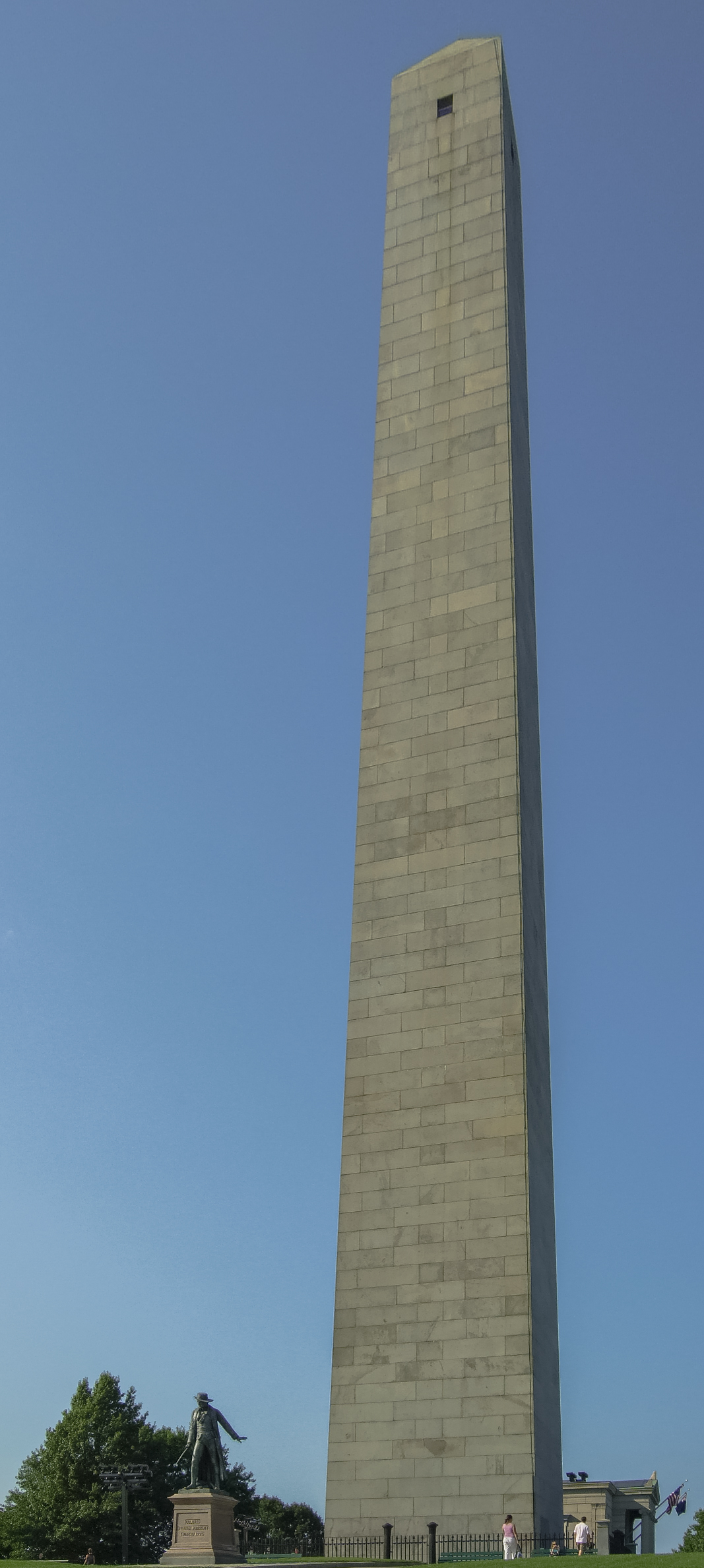
Bunker Hill Monument

A granite obelisk over Charlestown marking the ground where a beaten militia proved it could stand against the British army.

The Bunker Hill Monument is the towering granite obelisk that crowns the heights of Charlestown, raised to commemorate the Battle of Bunker Hill fought on June 17, 1775, one of the first major engagements of the American Revolution.

Though named for Bunker Hill, most of the fighting actually took place on the adjacent Breed's Hill, where the colonial militia dug in overnight and faced the assault of the British regulars.

The battle was technically a British victory, for the colonists ran low on powder and eventually withdrew, but they inflicted such heavy losses on the advancing redcoats that it became a moral triumph, proof that the raw American forces could stand and fight against the most powerful army in the world.

It is here that the famous order not to fire until you see the whites of their eyes is said to have rung out along the earthworks.

The monument's cornerstone was laid in 1825 by the Marquis de Lafayette, and the two-hundred-and-twenty-one-foot shaft was finally completed in 1843, funded through years of public subscription.

A narrow spiral staircase of two hundred and ninety-four steps climbs to a small observation chamber at the top, rewarding the effort with sweeping views over Charlestown, the harbor, and the downtown skyline.

A lodge and exhibits at the base, along with a nearby museum, tell the story of the battle and the long campaign to build the monument.

Visiting

The Bunker Hill Monument is managed by the National Park Service, and both the grounds and the climb to the top are free, though the staircase may open only during set hours and can close in extreme heat, so check ahead. It stands at the end of the Freedom Trail in Charlestown, reachable on foot across the Charlestown Bridge or by bus, and pairs well with a visit to the nearby USS Constitution. There is no elevator, so the climb demands a reasonable level of fitness.

Insider tip: Make the climb up all two hundred and ninety-four steps if you are able: the view from the cramped chamber at the top, out over the harbor and the skyline, is one of the best free panoramas in Boston, and few visitors bother with the stairs.

📍 View on Google Maps →

Frequently Asked Questions

What are the best landmarks to see if I only have limited time in Boston?

Prioritize the downtown and Beacon Hill cluster: the Massachusetts State House, Boston Common and the Public Garden, and Faneuil Hall with Quincy Market. Walk a stretch of the Freedom Trail to the Old State House and Paul Revere House, then head to Copley Square for Trinity Church and the Boston Public Library.

Which iconic Boston landmarks are free to visit?

Boston Common, the Public Garden, and Faneuil Hall are all free, as is walking the Freedom Trail and stepping inside the Massachusetts State House and the Boston Public Library's McKim Building. Trinity Church's sanctuary is free during limited hours, and boarding the USS Constitution is free with a valid ID.

How many days do I need to see Boston's iconic landmarks?

Two full days cover the essentials: one for the Freedom Trail from Boston Common through the North End to Charlestown, and another for Copley Square, the Public Garden, and a major museum. Three days is ideal, adding the Museum of Fine Arts, the Isabella Stewart Gardner Museum, and Fenway Park.

What is the best way to see Boston's history?

Walking the Freedom Trail is the best introduction, following the painted red line 2.5 miles past sixteen sites including the Old North Church, the Granary Burying Ground, and Bunker Hill Monument. A guided tour in period costume adds context, and a harbor cruise pairs well for views of the Charlestown Navy Yard and the skyline.

Is the View Boston observation deck at the Prudential Center worth it?

View Boston sits atop the Prudential Tower with 360 degree panoramas taking in the Charles River, the harbor, and Fenway Park, plus an open-air roof deck. For a free alternative, the top of Bunker Hill Monument rewards a 294 step climb with sweeping views over Charlestown and the harbor.

When is the best time of year to visit Boston's landmarks?

Late spring through early autumn is prime, with the Public Garden's Swan Boats running, Fenway in full swing, and comfortable weather for the Freedom Trail. Summer is liveliest but busiest, so book ahead. Autumn brings crisp air and thinner crowds. Winter is cold but festive, with the museums and historic interiors at their quietest.