Houston landmarks
Photo: Tony Webster · CC BY 2.0

Landmarks

Houston's Most Iconic Landmarks

A deep guide to Houston's iconic landmarks: Space Center Houston, the Menil, the Rothko Chapel, Hermann Park and the San Jacinto Monument, with visiting tips.

Houston was founded in 1836 by two brothers from New York, Augustus Chapman Allen and John Kirby Allen, who bought land along Buffalo Bayou and named their new town after Sam Houston, the hero of Texas independence.

From a muddy landing on the bayou, it grew into a railroad hub, a cotton port and then, after oil was discovered nearby and the Houston Ship Channel opened, one of the great energy capitals of the world.

Today it is the largest city in Texas and the fourth largest in the United States.

Houston's landmarks tell the story of a city that has always looked outward and upward. NASA's Mission Control guided the Apollo missions from Houston, and Neil Armstrong's famous message after the first Moon landing began with the city's name: "Houston, Tranquility Base here."

Oil fortunes built museums, parks and some of the most remarkable art spaces in the country, from the Menil Collection to the Rothko Chapel, while the battlefield of San Jacinto, just east of the city, marks the place where Texas won its independence.

This guide takes you through Houston's most iconic landmarks, with their history, practical visiting advice and tips to help you make the most of each one.

Distances are large, so group your visits by area: the Museum District and Montrose sit close together, downtown and Buffalo Bayou form another cluster, and Space Center Houston and San Jacinto each deserve their own half day.

Museum · Clear Lake · 1992

Space Center Houston

The official visitor center of NASA's Johnson Space Center, home of Mission Control and astronaut training.

When NASA chose Houston in the early 1960s for its new Manned Spacecraft Center, the city became the home of America's human spaceflight program. The center, renamed the Lyndon B.

Johnson Space Center in 1973, trained the astronauts and ran Mission Control for the Gemini, Apollo and space shuttle missions, and it still plays a central role in the International Space Station program.

Space Center Houston opened in 1992 as its official visitor center and became a Smithsonian Affiliate in 2014.

Inside, visitors can see real spacecraft, spacesuits, moon rocks and exhibits on the future of exploration. Outside, Independence Plaza places a full-scale shuttle replica atop NASA 905, one of the original Boeing 747 shuttle carrier aircraft, and visitors can walk through both.

The center also tells the stories of the astronauts and engineers who made the missions possible.

Tram tours leave the visitor center to visit parts of the Johnson Space Center, such as Rocket Park, where a complete Saturn V rocket lies in its own building, and, depending on the tour, the historic Apollo Mission Control room or astronaut training facilities.

Visiting

Buy tickets online and arrive early, as tram tours fill up on busy days and some tours cost extra. The center is about 25 miles southeast of downtown, so most visitors drive. Allow four to six hours, and check the daily schedule for tram departures and presentations.

Insider tip: Take the first tram tour of the day, then explore the indoor galleries when the crowds arrive.

📍 View on Google Maps →

Art museum · Museum District · Founded in 1900

Museum of Fine Arts, Houston

One of the largest art museums in the United States, spread across a campus of buildings, gardens and a light-filled tunnel.

The Museum of Fine Arts, Houston grew from an art league founded in 1900 and opened its first building in 1924, the first art museum building in Texas.

Over the following century, it expanded into a campus in the heart of the Museum District, with buildings by architects including Ludwig Mies van der Rohe, Rafael Moneo and Steven Holl, whose Nancy and Rich Kinder Building opened in 2020.

Its encyclopedic collections cover antiquities, European old masters, Impressionism, American art, photography, Latin American art and contemporary works.

A tunnel by the artist James Turrell, called The Light Inside, bathes visitors in shifting colored light as they walk between buildings, and the Lillie and Hugh Roy Cullen Sculpture Garden, designed by Isamu Noguchi, offers a calm outdoor gallery.

The museum also runs two house museums elsewhere in the city, Bayou Bend, with American decorative arts, and Rienzi, with European art, along with an art school.

Visiting

General admission to the permanent collection is free on Thursdays, while special exhibitions require tickets. The museum is on the METRORail Red Line at the Museum District station. Allow two to four hours, and check current hours before you go.

Insider tip: Walk through Turrell's tunnel slowly, then have lunch or dinner at Le Jardinier, the museum's Michelin-starred restaurant.

📍 View on Google Maps →

Art museum · Montrose · 1987

The Menil Collection

A free, serene museum by Renzo Piano, set in a neighborhood of gray bungalows and green lawns.

John and Dominique de Menil, collectors who arrived in Houston in the 1940s, gathered one of the most important private art collections of the 20th century, from antiquities and Byzantine icons to African and Oceanic art, surrealism and postwar American painting.

In 1987, the Menil Collection opened to the public in a building designed by the Italian architect Renzo Piano, his first museum in the United States.

The building is long and low, clad in gray cypress siding to match the surrounding bungalows, which the Menils also bought and painted the same color. Inside, a roof of curved white leaves filters natural light into the galleries, creating a calm, intimate atmosphere.

The campus has grown to include the Cy Twombly Gallery, the Menil Drawing Institute and outdoor art among its lawns.

The de Menils believed art should be accessible to everyone, and admission has always been free. The museum shows only a part of its collection at a time, so exhibitions change regularly.

Visiting

Admission is free. The museum is in Montrose, a short rideshare from the Museum District, and has free parking nearby. Allow one and a half to two hours, plus time for the Cy Twombly Gallery and the Rothko Chapel a few blocks away.

Insider tip: Have a picnic or a coffee on the lawn across from the main building, as locals do on sunny weekends.

📍 View on Google Maps →

Monument · Montrose · 1971

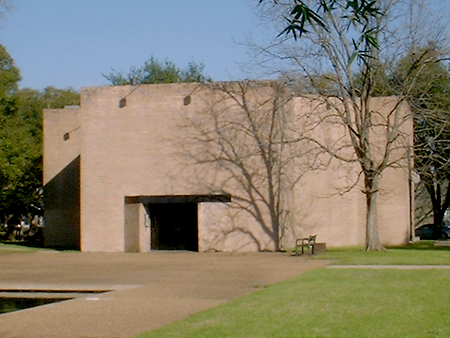
Rothko Chapel

An octagonal, nondenominational chapel holding fourteen large, dark paintings by Mark Rothko.

The Rothko Chapel was commissioned by John and Dominique de Menil, who asked the painter Mark Rothko to create a space for contemplation.

Rothko worked on the paintings for years and shaped the design of the octagonal building, but he died in 1970, a year before the chapel opened in February 1971. It was conceived as a place open to people of all faiths and of none.

Inside, fourteen large canvases in deep shades of black and purple hang on the walls, lit by a skylight. The paintings seem to change as the light shifts and as your eyes adjust, which is part of the experience. Benches and meditation cushions invite visitors to sit and stay.

Outside, Barnett Newman's sculpture Broken Obelisk stands in a reflecting pool, dedicated to the memory of Martin Luther King Jr. The chapel has also become a center for human rights, hosting talks and events.

Visiting

Admission is free and tickets are no longer required. The chapel is generally open Tuesday to Sunday, but it closes for some programs and private events, so check its calendar. Silence is expected inside. Allow 30 minutes to an hour.

Insider tip: Sit for at least ten minutes; the colors in the paintings slowly reveal themselves as your eyes adjust to the light.

📍 View on Google Maps →

Science museum · Museum District · Founded in 1909

Houston Museum of Natural Science

One of the most visited museums in the United States, with a famous dinosaur hall, gems and a butterfly rainforest.

The Houston Museum of Natural Science traces its roots to 1909 and moved to Hermann Park in the 1960s.

It has grown into one of the most visited museums in the country, with permanent halls covering paleontology, gems and minerals, ancient Egypt, energy, African wildlife and more.

The Morian Hall of Paleontology displays dinosaur and other prehistoric skeletons in dramatic poses, while the Cullen Hall of Gems and Minerals presents dazzling crystals and gemstones in dark galleries.

The Cockrell Butterfly Center is a three-story glass rainforest where hundreds of live butterflies fly freely around visitors.

A planetarium and a giant-screen theater complete the visit, and the museum runs a satellite location in Sugar Land and the George Observatory in Brazos Bend State Park.

Visiting

Tickets are sold for the permanent exhibit halls, with separate tickets for the butterfly center, planetarium and special exhibitions. The museum is on the edge of Hermann Park, near the Museum District rail station. Allow three hours or more.

Insider tip: Visit the butterfly center early in the day, when the butterflies are most active, and wear bright colors.

📍 View on Google Maps →

Urban Park · Museum District · 1914

Hermann Park

Houston's grand central park, home to the zoo, gardens, a lake and a free outdoor theater.

In 1914, the businessman George H. Hermann donated land south of the city to create a public park, and the planner George Kessler laid out its original design.

Over the following century, Hermann Park became the green heart of the Museum District, with a reflecting pool, a lake and a statue of Sam Houston on horseback at its main entrance.

Today, the park holds the Houston Zoo, the Japanese Garden, McGovern Centennial Gardens with its spiral mount, McGovern Lake with pedal boats, a miniature railroad and golf course.

Miller Outdoor Theatre, on a grassy hill, presents free concerts, plays, dance and films for much of the year.

The park is surrounded by museums, Rice University and the Texas Medical Center, and its paths link them into one of the most rewarding areas of the city to explore on foot.

Visiting

The park is free and open daily, though the zoo and some attractions charge admission. It is served by several METRORail Red Line stations. Allow a half day to combine the gardens with a museum or the zoo.

Insider tip: Climb the spiral mount in McGovern Centennial Gardens for a view over the treetops toward the Texas Medical Center towers.

📍 View on Google Maps →

Urban Park · Downtown · Redeveloped in 2015

Buffalo Bayou Park

A green ribbon of trails, gardens and public art along the bayou where Houston was founded.

Buffalo Bayou is the slow, winding waterway that gave birth to Houston in 1836.

For much of the 20th century, it was neglected, but a major transformation led by the Buffalo Bayou Partnership turned the stretch west of downtown into Buffalo Bayou Park, which reopened in 2015 with about 160 acres of trails, gardens, lawns and lighting.

The park follows the bayou for more than two miles between downtown and Shepherd Drive, with paved paths, bridges, a dog park, the Lost Lake area, kayak and bike rentals and public art.

Under the Waugh Drive Bridge, a colony of Mexican free-tailed bats lives in the expansion joints, emerging at dusk in warm months.

The park was designed to flood and recover, absorbing high water during storms, which makes it a model of how Houston lives with its bayous.

Visiting

The park is free and open daily. Paths are easily reached from downtown and the Fourth Ward, and there is parking near the visitor center. Allow one to three hours, depending on how far you walk or ride.

Insider tip: Come at dusk in summer to watch the bats leave the Waugh Drive Bridge, then walk back toward the illuminated skyline.

📍 View on Google Maps →

Historic monument · Downtown · 1926

Buffalo Bayou Park Cistern

A vast, cathedral-like underground reservoir with 221 columns and a long, haunting echo.

Built in 1926 as one of Houston's first underground drinking water reservoirs, the Cistern supplied the city for decades until a leak that could not be repaired put it out of service.

It was rediscovered by the Buffalo Bayou Partnership, which restored it and opened it to the public in 2016.

The space covers about 87,500 square feet and is supported by 221 slender concrete columns, each about 25 feet tall. A thin layer of water still covers the floor, reflecting the columns and creating the illusion of an endless forest of pillars.

The acoustics are remarkable, with an echo that lasts many seconds.

The Cistern also hosts immersive art installations, which use light and sound to transform the space.

Visiting

Visits are by guided tour or art installation, with timed tickets that should be booked in advance. The entrance is in Buffalo Bayou Park near Sabine Street. Allow about 30 to 45 minutes.

Insider tip: Stay quiet for a moment during the tour to hear how long a single sound echoes through the columns.

📍 View on Google Maps →

Monument · La Porte · 1939

San Jacinto Monument

A towering column over the battlefield where Texas won its independence from Mexico in 1836.

On April 21, 1836, Texan forces led by Sam Houston surprised and defeated the Mexican army of General Antonio López de Santa Anna on the plains of San Jacinto, east of present-day Houston, in a battle that lasted only minutes.

The victory secured the independence of Texas, which became a republic before joining the United States in 1845.

For the battle's centennial, Texas built the San Jacinto Monument, completed in 1939.

Faced with Texas limestone and topped by a large star, the column rises more than 567 feet, slightly taller than the Washington Monument, and is often described as the tallest monument column in the world.

A museum at its base tells the history of Texas from early times to statehood.

The surrounding San Jacinto Battleground State Historic Site preserves the battlefield, with markers explaining the events of the day.

Visiting

The monument and museum are east of Houston, about a 30-minute drive from downtown. A major restoration and new museum project is under way, and the observation floor has had reduced access, so check what is open before you go. Allow two hours.

Insider tip: Walk out onto the battlefield trail after visiting the museum to see how small and flat the ground really is.

📍 View on Google Maps →

Urban Park · Downtown · 2008

Discovery Green

A lively downtown park that turned parking lots into lawns, a lake and a stage for free events.

Discovery Green opened in 2008 on land that had largely been surface parking next to the George R. Brown Convention Center. Created through a partnership between the city and private philanthropists, the park quickly became one of downtown Houston's favorite gathering places.

Its 12 acres hold a lake, lawns, gardens, playgrounds, splash fountains, a dog run, public art and restaurants. Free events fill the calendar, from concerts and movie nights to fitness classes and markets, and in winter it often hosts an ice rink.

The park helped spark a wave of new hotels, apartments and restaurants in the surrounding blocks, turning the east side of downtown into a lively district.

Visiting

The park is free and open daily. It is a short walk from downtown hotels, the convention center and the ballparks. Allow an hour, or longer if there is an event.

Insider tip: Check the park's event calendar before your trip; there is often a free concert or festival on weekends.

📍 View on Google Maps →

Public Art · Uptown · Waterwall completed in 1985

Gerald D. Hines Waterwall Park

A 64-foot horseshoe-shaped fountain where water roars down both sides of its walls.

The Waterwall was designed by the architects Philip Johnson and John Burgee as part of the development of Williams Tower, the tall Uptown skyscraper originally known as the Transco Tower.

The semicircular fountain rises 64 feet, a height chosen to echo the tower's 64 floors, and was completed in the mid-1980s.

Water cascades down both the inner and outer faces of the wall, recirculating at about 11,000 gallons per minute. Standing inside the horseshoe, visitors are surrounded by the roar and the cool mist, a welcome relief in the Houston heat.

A lawn lined with live oaks leads up to the fountain.

The site was bought for public use in 2008 and renamed for the developer Gerald D. Hines, whose company built the tower and The Galleria nearby.

Visiting

The park is free and open daily, and the fountain usually runs from morning to evening. It is near The Galleria in Uptown, with paid parking nearby. Allow 20 to 30 minutes.

Insider tip: Visit at dusk, when the fountain is lit and the tower's rotating beacon begins to sweep the sky.

📍 View on Google Maps →

Frequently Asked Questions

What are the best landmarks to see if I only have limited time in Houston?

Spend a morning at Space Center Houston, then return to the city for the Museum District and Hermann Park. If you have a second day, visit the Menil Collection and the Rothko Chapel in Montrose, walk Buffalo Bayou Park and end at the Waterwall in Uptown at dusk.

Which Houston landmarks are free to visit?

The Menil Collection, the Rothko Chapel, Hermann Park, Buffalo Bayou Park, Discovery Green and the Gerald D. Hines Waterwall Park are free. The Museum of Fine Arts, Houston has free general admission on Thursdays, and the Contemporary Arts Museum Houston is always free.

How much time do I need at Space Center Houston?

Plan four to six hours, including a tram tour into NASA's Johnson Space Center. Tram tours can fill up, especially on weekends, so arrive early and buy tickets online in advance.

How do I get to Space Center Houston from downtown?

The center is about 25 miles southeast of downtown, in the Clear Lake area. Driving takes about 30 to 45 minutes without heavy traffic. Rideshare and organized tours are alternatives, as public transit is limited.

How do I get around Houston's main landmarks without a car?

The METRORail Red Line connects downtown with the Museum District, Hermann Park and the Texas Medical Center. Montrose is a short rideshare from the Museum District, and Buffalo Bayou Park is walkable from downtown. Space Center Houston and San Jacinto require a car or a tour.

When is the best time to visit Houston's outdoor landmarks?

October to April offers the most comfortable weather for parks and outdoor sites. In summer, visit early in the morning or late in the afternoon, carry water and plan indoor visits for the hottest hours.