Philadelphia landmarks
Photo: King of Hearts · CC BY-SA 3.0

Landmarks

Philadelphia's Most Iconic Landmarks

A deep guide to Philadelphia's iconic landmarks: Independence Hall, the Liberty Bell, and the Philadelphia Museum of Art, with history and insider visiting tips.

Philadelphia wears its history in red brick, white marble, and green squares.

This is the city William Penn laid out in 1682 as a grid of leafy public squares, the place where the Declaration of Independence and the Constitution were both debated and signed, and the young capital that gave the new republic its first bank, its first hospital, and its first stock exchange.

To walk its streets is to move through the founding of a nation, where a modest Georgian statehouse where liberty was declared sits a few blocks from a Gilded Age city hall crowned by a bronze William Penn, and where a Greek Revival temple of art crowns a hill at the end of a grand boulevard.

What makes Philadelphia's landmarks so compelling is that they are not isolated monuments. They gather in Old City around Independence Hall, march up the Benjamin Franklin Parkway toward the museum on the hill, and ring the leafy squares Penn planted three centuries ago.

The colonial and the modern argue with one another across narrow cobbled lanes, the public spaces invite you to linger, and the institutions hold collections and stories that shaped the country.

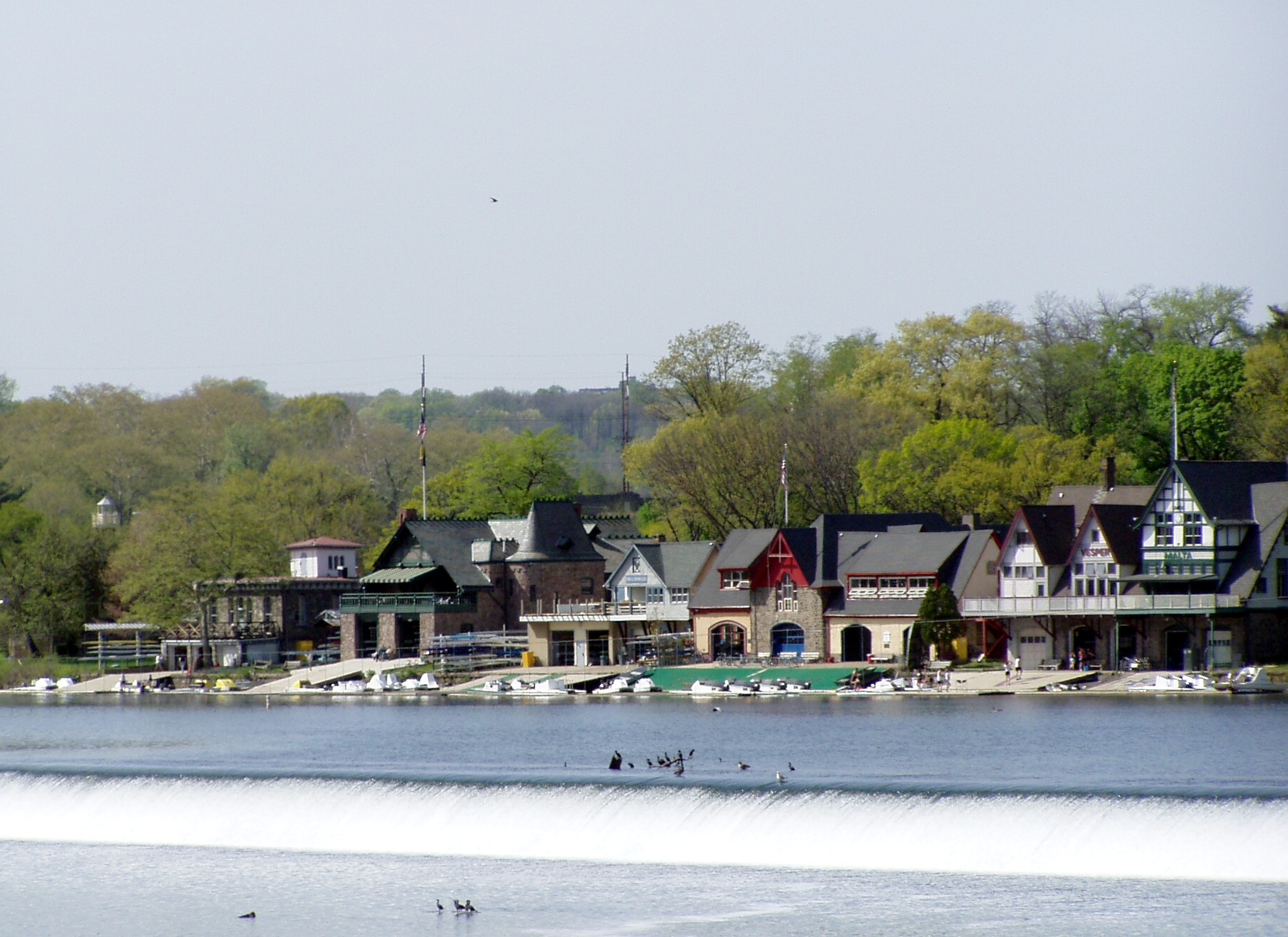
The Schuylkill and Delaware rivers frame the city and give it its light, with Boathouse Row glowing along the water at dusk.

This guide gathers eleven landmarks that define Philadelphia: the birthplace of American democracy, the beloved works of public art and architecture, the world-class museum on the hill, and the quiet residential lane that has been lived in longer than any other street in the country.

For each you will find what it is, why it matters, what to look for, and how to visit sensibly. Read it front to back for a historical narrative of the city, or skip to the places that call to you and build your own route through Old City and up the Parkway.

Historic · Old City · 1753

Independence Hall

The red-brick Georgian hall where a group of colonists argued a new nation into existence, twice over.

Independence Hall began life as the Pennsylvania State House, a dignified Georgian building of red brick and white trim raised over two decades and completed around 1753.

Designed with the help of lawyer Andrew Hamilton and master builder Edmund Woolley, its symmetrical facade and slender wooden steeple made it the grandest public building in the colonies, a fitting stage for the drama that would unfold inside.

In the plain, green-shuttered Assembly Room on the ground floor, the Second Continental Congress adopted the Declaration of Independence in the summer of 1776, and eleven years later delegates returned to the same room to hammer out the United States Constitution through a long, secretive Philadelphia summer.

The furnishings are sparse and the scale surprisingly intimate, which only sharpens the sense that world-changing decisions were made by real people sweating around these tables.

At the front of the room sits the original rising-sun chair in which George Washington presided, the carving that led Benjamin Franklin to remark that he could finally tell it was a rising and not a setting sun.

Recognized on the UNESCO World Heritage List, the hall anchors Independence National Historical Park, and stepping across its worn floorboards remains one of the most direct encounters with the American founding that any visitor can have.

Visiting

Independence Hall can only be seen on a ranger-led tour, and from spring through fall free timed tickets are required, distributed by the National Park Service online for a small reservation fee or in person at the Independence Visitor Center. In the quieter winter months tickets are often not needed. Arrive early, since same-day passes go quickly, and allow time to clear an airport-style security screening beforehand. The tour itself runs a brisk half hour or so, but the surrounding park deserves much more.

Insider tip: Reserve your timed ticket online weeks ahead in summer, then use the wait before your slot to walk to the second-floor Great Essentials exhibit at the West Wing, where original printed copies of the Declaration and Constitution are displayed for free.

📍 View on Google Maps →

Historic · Independence Mall · 1752

Liberty Bell

A cracked bronze bell whose flawed voice came to ring for freedom far beyond the day it was cast.

The Liberty Bell hangs in its own glass pavilion across from Independence Hall, a two-thousand-pound bronze bell first cast in London and delivered to Philadelphia in 1752 for the Pennsylvania State House.

It cracked on its very first test ring and was twice recast by local founders John Pass and John Stow, whose names still march across its waist, though the famous zigzag fracture we see today opened up decades later and silenced it for good.

Around the crown runs its now-famous inscription, a line from Leviticus: Proclaim liberty throughout all the land unto all the inhabitants thereof.

That biblical charge was chosen long before independence, but in the nineteenth century abolitionists seized on it, giving the object the name Liberty Bell and turning a colonial artifact into a moving symbol of the unfinished work of freedom for the enslaved.

Since then the bell has been embraced by suffragists, civil rights marchers, and movements around the world, its silent crack somehow amplifying rather than diminishing its power.

Displayed today in the Liberty Bell Center with the tower of Independence Hall framed in the glass behind it, the humble, damaged bell draws visitors from every continent who come to stand quietly before an idea made metal.

Visiting

The Liberty Bell Center is free and open daily, no ticket required, though a security screening at the entrance can create a line during peak hours. A series of exhibits leads visitors past the history and mythology of the bell before delivering them to the chamber itself. Come right at opening or in the last hour of the day to have room to breathe around the bell, since midday tour groups can pack the space. Allow twenty to forty minutes depending on how much of the interpretive display you read.

Insider tip: Walk to the far end of the chamber and photograph the bell from the rear: the tall window there lines up the crack with the steeple of Independence Hall across the mall, a single frame that tells the whole story.

📍 View on Google Maps →

Museum · Fairmount · 1928

Philadelphia Museum of Art

A honey-colored Greek temple on a hill, guarding a world-class collection at the top of the most famous steps in film.

The Philadelphia Museum of Art crowns a rise at the head of the Benjamin Franklin Parkway, a vast Greek Revival temple in golden Minnesota dolomite that opened in 1928.

Its long colonnaded wings and pedimented pavilions were meant to evoke ancient Athens, and from the top of its broad east stairs the view straight down the Parkway to City Hall is one of the grandest urban vistas in the country.

Those stairs are, of course, the Rocky Steps, immortalized when a fictional boxer sprinted up them and threw his arms skyward, and a bronze statue of the character now stands at their base.

But the building holds far more than a movie moment: it is one of the largest art museums in the United States, with more than two hundred galleries spanning ancient Asian sculpture, medieval European cloisters, and a sweeping collection of American and modern art, including the world's deepest holding of works by Marcel Duchamp.

Inside you can wander through a reconstructed Japanese teahouse, a pillared hall from a South Indian temple, and rooms hung with Cézanne, van Gogh, and Brancusi, then step into galleries devoted to arms and armor or Pennsylvania Dutch craft.

The sheer range rewards both a targeted visit to a few favorites and a leisurely day of drifting, with the Parkway and the river always waiting beyond the tall windows.

Visiting

The museum is open most days but typically closes one or two weekdays, so check the schedule before setting out. General admission tickets cover the main building and are valid across a nearby second day, and the museum offers pay-what-you-wish hours on certain evenings and one Sunday a month that are worth planning around. It sits at the western end of the Parkway, walkable from Center City or reachable by bus, with paid parking nearby. Give yourself at least two hours, or a full afternoon to roam.

Insider tip: Run or stroll up the front steps for the classic photo, then walk around to the far side of the building: the West Entrance faces the river and Boathouse Row and lets you slip in past the crowds gathered around the Rocky statue out front.

📍 View on Google Maps →

Historic · Center City · 1893

Reading Terminal Market

A cavernous 19th-century food hall where Amish bakers, cheesemongers, and roast pork carvers have fed the city for generations.

Reading Terminal Market fills a block-long hall beneath what was once the train shed of the Reading Railroad, opened in 1893 as a modern, sanitary home for the food vendors the new terminal had displaced.

It survives today as one of the oldest continuously operating public markets in America, a low-ceilinged maze of stalls where the smell of frying scrapple, fresh doughnuts, and roasting coffee hangs thick in the air.

The market is famous for its Pennsylvania Dutch merchants, Amish and Mennonite families who drive in from Lancaster County to sell soft pretzels, shoofly pie, and hand-rolled cinnamon buns from long communal counters.

Alongside them are Philadelphia institutions: DiNic's, whose roast pork sandwich with sharp provolone and broccoli rabe is often crowned the city's best, and Bassetts Ice Cream, which has scooped from the same corner since the market opened and claims to be the country's oldest ice cream company.

More than a place to eat, the market is a cross-section of the city itself, where office workers, tourists, and longtime regulars jostle at the same butcher cases and lunch counters.

You can buy raw oysters, Amish quilts, imported spices, and cut flowers within a few steps of one another, then find a shared table in the noisy center of it all to eat whatever you have gathered.

Visiting

Reading Terminal Market is open daily, though not every stall keeps the same hours, and the Amish vendors are generally present only from Wednesday through Saturday, so plan around them if the Pennsylvania Dutch food is your goal. It stands beside the convention center in Center City, an easy walk from City Hall and the historic district. Go on a weekday late morning to beat the lunchtime crush, and bring cash, since a few vendors still prefer it. Seating is first come, first served at communal tables.

Insider tip: Come hungry but do not commit to the first line you see: walk the entire market once to survey every counter, then double back for the roast pork at DiNic's and a scoop from Bassetts to finish.

📍 View on Google Maps →

Historic · Fairmount · 1829

Eastern State Penitentiary

A crumbling castle of solitary cells that once tried to reform criminals through silence and now stands hauntingly open to the sky.

Eastern State Penitentiary rises behind thirty-foot stone walls in the Fairmount neighborhood, a forbidding fortress that opened in 1829 as one of the most influential and expensive buildings in the young nation.

Designed by John Haviland on a radial plan, its long cellblocks fan out like the spokes of a wheel from a central hub, so that a single guard could survey every corridor at a glance.

The prison was built to enact a radical idea known as the Pennsylvania System, which held that criminals could be reformed through total isolation, silence, and penitence, the very word that gives us penitentiary.

Prisoners lived alone in vaulted skylit cells with private exercise yards, hooded whenever they were moved, meant to confront their consciences in complete solitude.

The regime drew visitors and critics from around the world, including Charles Dickens, who found the enforced solitude cruel rather than curative.

Over its long life the prison held infamous inmates, among them Al Capone, whose relatively comfortable furnished cell can still be seen, and the bank robber Willie Sutton.

Abandoned in 1971 and left to decay, it reopened as a historic site where visitors walk crumbling corridors under peeling plaster and collapsing roofs, an atmospheric ruin whose faded grandeur makes for one of the most memorable and unsettling landmarks in the city.

Visiting

Eastern State Penitentiary is open daily for daytime tours, with admission that includes an excellent audio guide narrated in part by the actor Steve Buscemi. It sits a short walk from the Art Museum and the Barnes Foundation, so it pairs naturally with a Parkway itinerary. Wear sturdy shoes and dress for the weather, since much of the site is unheated, roofless, and rough underfoot. Each autumn the prison transforms into a large-scale haunted attraction called Halloween Nights, which requires separate, pricier tickets.

Insider tip: Do not skip the audio tour and give yourself a full ninety minutes: the marked side stories, from the escape tunnel to Capone's cell, are the difference between a quick photo walk and truly understanding the strange experiment these walls contained.

📍 View on Google Maps →

Historic · Center City · 1901

Philadelphia City Hall

An extravagant granite palace topped by a bronze William Penn, once the tallest habitable building on earth.

Philadelphia City Hall stands squarely at the crossing of Broad and Market Streets, an enormous Second Empire pile of granite, marble, and brick that took three decades to build and was finally completed in 1901. Designed by John McArthur Jr.

and lavished with hundreds of sculptures by Alexander Milne Calder, it was for a brief moment the tallest habitable building in the world, and it remains the tallest load-bearing masonry structure ever raised, its walls at the base an astonishing twenty-two feet thick.

Crowning the tower is Calder's colossal bronze statue of William Penn, the Quaker founder of Pennsylvania, standing thirty-seven feet tall with his hand outstretched over the city he laid out.

For most of the twentieth century a gentlemen's agreement kept every new skyscraper below the brim of Penn's hat, a genteel restraint finally broken in 1987, and local superstition long blamed the city's sports droughts on the slight to the founder.

Far from a mere backdrop, City Hall is a working seat of government riddled with ornate courtrooms and council chambers, arranged around a public courtyard that anyone can walk through.

An observation deck just beneath Penn's feet offers an intimate, dead-center panorama of the city grid he devised, and the building's sheer sculptural exuberance rewards a slow circle of its four ornate facades.

Visiting

City Hall's central courtyard is open and free to pass through, and guided interior tours plus a separate tower elevator trip to the observation deck are offered on weekdays from a visitor center inside. The tower deck is small and timed, so tickets can sell out, and booking ahead is wise. It could not be more central, sitting atop its own subway station at the heart of Center City. Note that the building closes on weekends, when only the exterior and courtyard can be enjoyed.

Insider tip: Book the tower elevator for a clear day and go up late in the afternoon: standing at the base of the Penn statue with the whole grid radiating outward gives a far more personal view than the taller commercial decks nearby.

📍 View on Google Maps →

Historic · Old City · 1703

Elfreth's Alley

A narrow cobbled lane of colonial rowhouses, lived in without pause for more than three centuries.

Elfreth's Alley is a slim cobblestone lane tucked between busy Old City streets, lined with thirty-two brick rowhouses that trace their origins to the early eighteenth century.

Often called the oldest continuously inhabited residential street in the United States, it has sheltered Philadelphians without interruption since around 1703, and people still live behind most of its shuttered windows and painted front doors today.

The houses are modest by design, built for the artisans and tradespeople who powered the colonial port: blacksmiths, silversmiths, shoemakers, and mantua-makers who worked and slept within these tight brick walls.

Their varied Georgian and Federal facades, the flower boxes, the pump and the wooden benches, together preserve the intimate scale of a working street from a time before the automobile, a rare survivor in a city that grew up all around it.

At the heart of the alley two of the oldest houses have been joined into a small museum that tells the stories of the ordinary families who lived here, and once a year on Fete Day residents open their private doors to the public.

Walking its short length is like stepping into a pocket of the eighteenth century, quiet and residential, asking only that visitors tread gently past homes that are still very much in use.

Visiting

Elfreth's Alley itself is a public street, free to walk at any hour, but remember that these are private residences and residents ask that visitors keep their voices down and stay off the stoops. The small Elfreth's Alley Museum at numbers 124 and 126 keeps limited seasonal hours and charges a modest admission for a look inside a period home. The alley lies a few blocks from Independence Hall and the Betsy Ross House, folding easily into a historic-district walk. Early morning gives the emptiest, most atmospheric photographs.

Insider tip: Visit soon after sunrise before the tour groups arrive: the low light on the cobbles and brick is lovely, and you will have the quiet lane almost to yourself, which is also the most respectful time to enjoy a street full of people's homes.

📍 View on Google Maps →

Historic · Old City · 1740

Betsy Ross House

A tiny colonial home on Arch Street tied to the enduring legend of the first American flag.

The Betsy Ross House is a small, steep-roofed brick dwelling on Arch Street, a characteristic Philadelphia trinity house from the mid-eighteenth century, its rooms stacked one to a floor and connected by winding stairs.

It is preserved as the home of Elizabeth Griscom Ross, a working upholsterer and flagmaker who lived and labored in this crowded quarter of the colonial city.

The house owes its fame to a cherished national story: that here Betsy Ross was visited by George Washington and other patriots and sewed the first Stars and Stripes, suggesting the five-pointed star that could be made with a single snip of the scissors.

Historians caution that the tale rests largely on family recollection told decades later and cannot be firmly proven, yet the legend has made Ross one of the most famous women of the Revolution and this modest house a place of pilgrimage.

Beyond the flag story, the restored interior offers a vivid picture of the cramped, industrious life of a colonial tradeswoman, from the upholstery shop to the tiny bedchambers and courtyard.

Costumed interpreters, including one portraying Ross at work, bring the household to life, and the site treats the myth honestly while celebrating the real woman who ran a business and raised a family through the upheavals of the founding era.

Visiting

The Betsy Ross House is open most days, though it may close one weekday in the off season, and it charges a modest admission, with a small extra fee for a self-guided audio tour. It stands on Arch Street a short walk from Elfreth's Alley and the historic core, and the courtyard out front, where Ross is buried, can be enjoyed for free. The house is compact and its stairs are narrow and steep, so expect a quick but atmospheric visit of thirty to forty-five minutes. Weekday mornings are least crowded.

Insider tip: Time your visit for one of the daily performances by the costumed Betsy Ross interpreter in the upholstery shop: hearing her answer questions in character turns a fast walk-through of small rooms into a genuine conversation with the eighteenth century.

📍 View on Google Maps →

Public Art · South Street · 2008

Philadelphia's Magic Gardens

A shimmering labyrinth of mosaic built from bottles, tiles, and mirrors by a single obsessive artist.

Philadelphia's Magic Gardens sprawls across a former vacant lot on South Street, a dazzling immersive artwork covering half a city block that the artist Isaiah Zagar spent years encrusting with mosaic.

Walls, tunnels, and grottoes glitter with hand-glazed tiles, mirror shards, colored bottles, bicycle wheels, and folk figures, all set into swirling cement by hand into one continuous, dreamlike environment.

Zagar began transforming the derelict lots near his studio in the 1990s, and when the land was threatened with sale the surrounding community rallied to preserve his sprawling creation, which opened to the public as a nonprofit garden in 2008.

It is the largest of the hundreds of mosaic murals Zagar has scattered across the South Street neighborhood, a personal cosmology of recurring faces, phrases, and found objects that reward slow, curious looking.

Visitors wind through indoor galleries and out into a maze of open-air courtyards and sculpted passageways where nearly every surface, underfoot and overhead, is alive with reflection and pattern.

Statues, poems scratched into the grout, and improbable arrangements of dishware turn the whole place into a walk-in collage, at once chaotic and meditative, unlike any other landmark in a city otherwise defined by its colonial brick.

Visiting

Philadelphia's Magic Gardens is open most days with timed tickets that are best reserved in advance, since the intimate space limits how many people can enter at once and weekend slots sell out. It sits in the lively South Street corridor, an easy walk from Society Hill and lined with more of Zagar's murals in every direction. Give yourself an hour to wander the indoor and outdoor sections fully, and note that the labyrinth is uneven underfoot and largely uncovered, so check the weather. Photography for personal use is welcome.

Insider tip: After you tour the Gardens themselves, spend twenty minutes strolling the surrounding blocks: Zagar covered dozens of nearby walls and alleys with free mosaics, and hunting them down turns a single ticketed stop into a self-guided open-air gallery.

📍 View on Google Maps →

Park · Fairmount · 1861

Boathouse Row

A string of Victorian boathouses along the Schuylkill, outlined at night in a necklace of lights.

Boathouse Row is a picturesque line of fifteen historic boathouses set along the east bank of the Schuylkill River just above the Fairmount Water Works, home to the amateur rowing clubs collectively known as the Schuylkill Navy, the oldest amateur athletic governing body in the country.

The clubs took root here in the mid-nineteenth century, and the eclectic Victorian and Tudor-style buildings that followed give the riverbank the look of a genteel English retreat.

Rowing has been woven into Philadelphia life ever since, and the painter Thomas Eakins, a native son, made the scullers of the Schuylkill famous in a celebrated series of canvases that captured the sport's quiet discipline.

On almost any morning you can still watch eights and singles slicing through the flat water below the houses, oars flashing in unison against the current.

After dark the row performs its most famous trick: each boathouse is traced in thousands of small lights that turn the whole ensemble into a glowing necklace mirrored in the black river, a sight beloved from the nearby Art Museum steps and the busy expressway across the water.

Backed by the greenery of Fairmount Park and threaded by the popular Kelly Drive path, the row is a favorite of runners, cyclists, and rowers who share one of the loveliest stretches of urban riverfront in the city.

Visiting

Boathouse Row is best appreciated from the outside, as the houses are private clubs, and it is free and accessible at all hours along Kelly Drive and the riverside trail that runs past it. The classic view comes from across the river or from the west terrace of the Philadelphia Museum of Art, especially at night when the outlines are lit. Come at dusk to catch the lights switching on and reflecting in the water, and bring a bike or good shoes if you want to follow the scenic path upriver. There is no admission and no set hours.

Insider tip: For the postcard shot, cross to the west bank near the Water Works or climb to the Art Museum's river-facing terrace at blue hour: the illuminated houses double perfectly in the calm Schuylkill just after sunset.

📍 View on Google Maps →

Skyscraper · Center City · 1987

One Liberty Observation Deck

A blue-glass spire that finally topped William Penn's hat, offering a bird's-eye sweep of the entire city.

One Liberty Place is the sleek blue-glass skyscraper that broke Philadelphia's oldest architectural taboo, rising in 1987 as the first building in the city to climb higher than the statue of William Penn atop City Hall.

Designed by the architect Helmut Jahn, its stepped, spire-topped silhouette drew inspiration from New York's Chrysler Building yet reads as unmistakably modern, and its arrival ended the gentlemen's agreement that had kept the skyline low for nearly a century.

High inside the tower, on the fifty-seventh floor, the One Liberty Observation Deck offers a full three-hundred-sixty-degree panorama some eight hundred and eighty feet above the streets.

From here the city unfolds in every direction: the ruler-straight lines of Penn's original grid, the ribbon of the Delaware River and the bridges to New Jersey, the green expanse of Fairmount Park, and, directly below, the ornate roof and tower of City Hall that the building was once forbidden to overtop.

The deck pairs its views with interactive exhibits and a hometown flourish narrated in the spirit of local basketball legend Julius Erving, giving visitors a sense of the neighborhoods spread beneath them.

On a clear day the sightlines stretch far into Pennsylvania and New Jersey, and at dusk the grid ignites below, making this the single best vantage for grasping how Penn's tidy seventeenth-century plan grew into a modern metropolis.

Visiting

The One Liberty Observation Deck is open most days with timed tickets sold online and at the door, and it sits atop a shopping concourse in the heart of Center City, steps from City Hall and its subway station. Because the deck is entirely enclosed, it makes a fine rainy-day or cold-weather stop when outdoor views are off the table. Aim for late afternoon so you can watch the transition from daylight to a glittering nighttime grid on a single ticket. Allow about an hour to take in the views and exhibits.

Insider tip: Go up roughly forty-five minutes before sunset: you will see the city by day, watch the light turn gold over Fairmount Park to the west, and stay as the whole grid lights up beneath you, all without leaving the deck.

📍 View on Google Maps →

Frequently Asked Questions

What are the best landmarks to see if I only have limited time in Philadelphia?

Prioritize the Old City cluster: Independence Hall and the Liberty Bell in Independence National Historical Park, then walk to Elfreth's Alley and the historic squares. Save an afternoon for the Philadelphia Museum of Art, the famous Rocky Steps, and the Benjamin Franklin Parkway.

Which iconic Philadelphia landmarks are free to visit?

The Liberty Bell Center, Independence Hall, and Independence National Historical Park are all free, though Independence Hall requires a timed ticket in peak season. LOVE Park, Rittenhouse Square, City Hall's courtyard, Elfreth's Alley, and the Rocky Steps are free to enjoy any time.

How many days do I need to see Philadelphia's iconic landmarks?

Two full days cover the essentials: one for Old City with Independence Hall, the Liberty Bell, and Reading Terminal Market, and another for the Benjamin Franklin Parkway, the Philadelphia Museum of Art, and City Hall. Three days is ideal, adding Eastern State Penitentiary and Boathouse Row.

What is the best way to see Philadelphia's history and architecture?

Start on foot in Independence National Historical Park, where the founding sites sit within a few walkable blocks. A ranger-led tour of Independence Hall gives the best context, and a stroll up the Benjamin Franklin Parkway ties the colonial core to the grand museum district.

Should I go up City Hall Tower or the One Liberty Observation Deck for the view?

One Liberty Observation Deck sits on the 57th floor at roughly 883 feet and offers the most expansive, enclosed panorama. City Hall Tower's observation deck stands just below the William Penn statue at about 500 feet, smaller and reached by a tiny elevator. Choose City Hall for history and the closest look at Penn, One Liberty for altitude.

When is the best time of year to visit Philadelphia's landmarks?

Late spring through early autumn is prime, with blossoming squares, Parkway festivals, and long daylight on the Rocky Steps. Summer is liveliest but busiest, and the Fourth of July draws crowds to Independence Hall, so book ahead. Autumn brings thinner crowds and crisp river light. Winter offers festive markets and indoor museums.