Toronto landmarks
Photo: Jchmrt · CC BY-SA 4.0

Landmarks

Toronto's Most Iconic Landmarks

A deep guide to Toronto's iconic landmarks: the CN Tower, Casa Loma, and the Royal Ontario Museum, with history and insider visiting tips.

Toronto wears its ambition in glass, brick, and Credit Valley stone.

This is the city that grew from a muddy colonial outpost called York into Canada's largest metropolis, that once reached higher into the sky than anywhere else on Earth, and that turned a working harbour on Lake Ontario into a waterfront of parks, ferries, and island beaches open to everyone.

To walk its streets is to move through layers of history, where a Gothic Revival castle looks down from the escarpment, a Beaux-Arts train hall anchors the downtown core, and a crystalline museum addition juts out over a century-old sandstone facade.

What makes Toronto's landmarks so compelling is how they gather the city's many neighbourhoods into one story. They rise along Yonge Street and Bloor, ring Nathan Phillips Square, and line the harbour in a way that lets you read the city's growth decade by decade.

The old and the new argue across the street from one another, the public spaces invite crowds to skate and gather, and the museums and galleries hold collections drawn from every part of the world Toronto's immigrants have come from.

The lake, vast and open as an inland sea, ties it all together and gives the city its light.

This guide gathers eleven landmarks that define Toronto: the record-setting tower, the beloved civic squares, the world-class museums, and the restored Victorian district that changed how the city thinks about its industrial past.

For each you will find what it is, why it matters, what to look for, and how to visit sensibly. Read it front to back for an architectural narrative of the city, or skip to the places that call to you and build your own route along Yonge Street and the harbourfront.

Tower · Entertainment District · 1976

CN Tower

Step onto a pane of glass more than a hundred storeys up and watch the whole city, the lake, and the ferries drift by beneath your shoes.

The CN Tower is the slender concrete needle that dominates Toronto's skyline, rising 553.3 metres above the rail lands at the foot of downtown.

Built by Canadian National as a broadcasting and communications mast, it was engineered to punch television and radio signals cleanly over the tall buildings that were crowding the city core, and in doing so it became the tallest free-standing structure in the world, a title it held for more than three decades until Dubai's Burj Khalifa overtook it in 2007.

The public experience climbs in stages.

Glass-fronted elevators race up the exterior in under a minute to the main LookOut level, where floor-to-ceiling windows open onto a panorama that on a clear day reaches across Lake Ontario toward Niagara and the mist rising from the falls.

One level down waits the tower's most famous dare, the Glass Floor, a transparent panel that leaves nothing but air between you and the ground far below. Higher still, the SkyPod at 447 metres offers the loftiest enclosed view in the country.

For the truly fearless, EdgeWalk sends harnessed visitors on a hands-free stroll around the rim of the main pod, leaning back over the edge with the city spread out beneath them.

Back inside, the revolving 360 Restaurant turns a slow full circle roughly every hour, so a single meal delivers the entire horizon.

Whatever level you choose, the tower is the clearest way to read Toronto: the grid of downtown, the green islands offshore, and the endless blue plane of the lake.

Visiting

The CN Tower is open daily with extended hours in summer, and buying timed tickets online in advance is strongly recommended to skip the longest queues, especially on weekends and during festival season. Entry is at the base on Bremner Boulevard, a short walk from Union Station. EdgeWalk runs seasonally in fair weather and must be booked separately, and it includes access to the observation levels. Go on a clear day, since haze can flatten the distant view, and allow at least an hour, more if you plan to dine or walk the edge.

Insider tip: Arrive about an hour before sunset: you can take in the daytime view, watch the light fade over the lake, and then see the downtown towers switch on at dusk, all on one ticket, with far shorter lines than at midday.

📍 View on Google Maps →

Public Art · Downtown / Nathan Phillips Square · 2015

3D Toronto Sign

Giant illuminated letters that glow in the colours of the moment, framing City Hall and the crowds who come to pose in front of them.

The 3D Toronto Sign stands in Nathan Phillips Square, the civic plaza in front of City Hall, spelling out the city's name in oversized block letters that have become one of the most photographed spots in the country.

It was installed as a temporary feature for the 2015 Pan American Games and proved so instantly popular with residents and visitors that the city kept it, later replacing the original with a sturdier, energy-efficient version designed to last.

What makes the sign more than a novelty is its programmable lighting.

After dark the letters wash through changing colours, often lit to mark holidays, causes, tragedies, and celebrations, so the same word can glow rainbow for Pride, red and white on Canada Day, or a single sombre hue in remembrance.

A maple leaf and other emblems sit alongside the letters, and the whole ensemble reads as a nightly civic mood ring for the city.

The sign anchors a plaza that is a landmark in its own right, with its curving concrete walkways, reflecting pool, and the sculptural arches added in a later redesign.

In winter the pool becomes a skating rink, and the letters preside over the skaters; in summer the square fills with markets, concerts, and lunchtime crowds. Together the sign and the square make an easy, free, and genuinely lively first stop downtown.

Visiting

The 3D Toronto Sign sits in Nathan Phillips Square, which is free and open to the public at all hours, so there is no ticket and no line, simply walk in from Queen Street West or Bay Street. For photographs with the letters lit and reflecting in the pool, come after dark, when the colour programme is at its best. Daytime visits pair naturally with a look at City Hall behind it, and winter brings skaters gliding across the frozen pool in the foreground.

Insider tip: Visit after nightfall and stand back far enough to catch the lit letters mirrored in the reflecting pool: the doubled glow, with the curved City Hall towers rising behind, is the shot most daytime visitors miss entirely.

📍 View on Google Maps →

Historic · Casa Loma / South Hill · 1914

Casa Loma

A Gothic Revival fantasy castle of turrets, secret passages, and stables, perched on the hill above the city like a piece of imported Europe.

Casa Loma is the turreted mansion that crowns the escarpment of Davenport Hill, a Gothic Revival castle built between 1911 and 1914 for the financier Sir Henry Pellatt, who made his fortune bringing hydroelectric power to Toronto. Designed by the prominent architect E. J.

Lennox, it was among the largest private homes ever raised in Canada, with nearly a hundred rooms, soaring towers, and a price tag that would eventually help ruin its owner.

Inside, the house is a study in Edwardian ambition and imported grandeur: an oak-panelled Great Hall rising to a beamed ceiling, a conservatory beneath a stained-glass dome, wood-panelled libraries, and a suite of period rooms filled with the comforts of a bygone gilded age.

An 800-foot tunnel runs underground to the stables and carriage room, where the horses were reputedly housed in mahogany stalls, and the two towers reward the climb with views out over the rooftops toward the lake.

Pellatt lived in his castle for less than a decade before mounting debts and taxes forced him out, and the house passed through uncertain years before the city took it on as a public attraction.

Today it operates as a historic house museum and event venue, its terraced gardens open in the warmer months, and it has served as a filming location for countless movies and television series drawn to its improbable, romantic silhouette above the modern city.

Visiting

Casa Loma is open daily and requires a timed ticket, best purchased online in advance, particularly on weekends and holidays. It sits atop the hill at the north end of Spadina Road, reachable by subway to Dupont station and a short uphill walk, or by car with paid parking nearby. Plan on roughly two hours to explore the rooms, climb the towers, and walk the tunnel to the stables, and add time in summer for the terraced gardens, which are open seasonally. Self-guided audio tours are included with admission.

Insider tip: Head for the towers early in your visit before the crowds build, then walk the underground tunnel to the stables on your way out: many visitors linger in the main rooms and never make it to the atmospheric passage and carriage house beyond.

📍 View on Google Maps →

Historic · Financial District · 1927

Union Station

A soaring Beaux-Arts temple to the railway age, where a great stone hall funnels the whole city onto the tracks below.

Union Station stretches along Front Street opposite the Royal York Hotel, a monumental Beaux-Arts railway station and the busiest transportation hub in Canada.

Opened in 1927 after years of construction, it was conceived as a grand gateway to the city, a civic statement in Bedford limestone with a long colonnade of towering columns marching across its facade toward the financial towers behind.

The heart of the building is the Great Hall, a vast ticketing concourse capped by a coffered vaulted ceiling of Guastavino tile that rises to more than twenty metres.

Bands of stone high on the walls are carved with the names of the towns and cities once served by the railways that met here, a roll call of Canadian geography running the length of the room.

Tall arched windows at either end flood the space with light, and the scale still stops travellers in their tracks.

Behind the passenger halls, the Bush-style train shed shelters the platforms where commuter, intercity, and national rail lines converge.

A long restoration and expansion carved out a bustling lower concourse of shops and restaurants beneath the historic rooms, so the station now works as both a working transit hub for hundreds of thousands of daily riders and a destination in its own right, linked underground to the sprawling PATH network and steps from the waterfront and the CN Tower.

Visiting

Union Station is open every day as an active transit hub, so the historic public spaces are free to walk through at any reasonable hour, though they are busiest during weekday commuter rushes. It is the central node for GO Transit, VIA Rail, the UP Express to the airport, the subway, and streetcars, making it an easy stop between the waterfront and downtown. Come mid-morning or on a weekend to admire the Great Hall without the crush, and look up to read the carved city names ringing the room.

Insider tip: Step into the Great Hall and walk its full length looking up at the tiled vault and the ribbon of carved place names: most commuters hurry straight through to the trains and never pause to take in one of the finest interior spaces in the city.

📍 View on Google Maps →

Museum · Bloor Street / Yorkville · 1914

Royal Ontario Museum

A century-old museum of nature and world cultures burst open by a jagged crystal of glass and steel that spills onto Bloor Street.

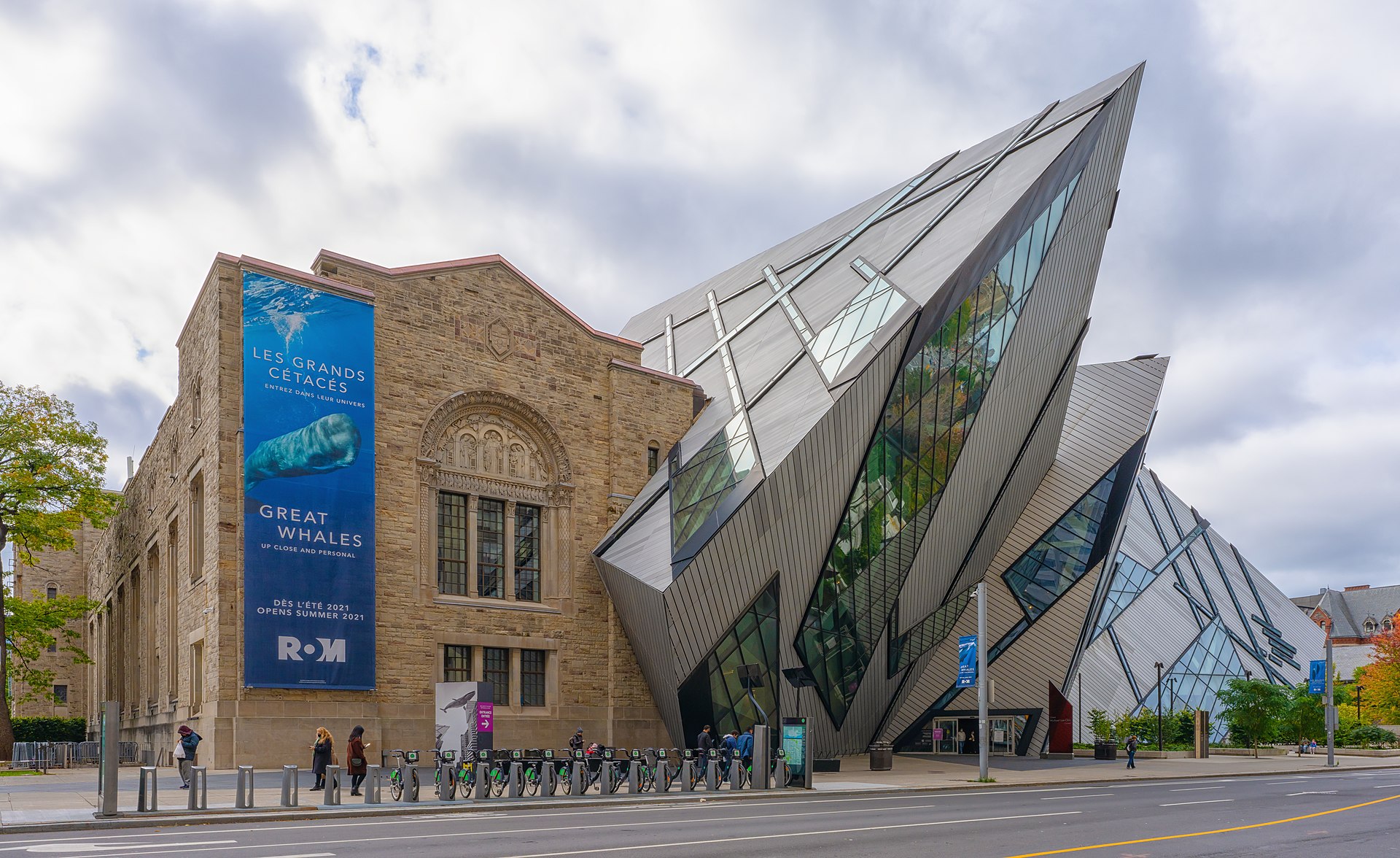
The Royal Ontario Museum, known to everyone as the ROM, is the largest museum in Canada and one of the great encyclopedic collections in North America, spanning natural history and world cultures under a single roof.

Its original heritage buildings, opened in 1914 and expanded over the following decades, present a dignified stone-and-tile facade, most famously the vaulted rotunda whose ceiling glitters with gold mosaic.

In 2007 the museum grafted a startling addition onto that historic core: the Michael Lee-Chin Crystal, a deconstructivist eruption of angled aluminium and glass by architect Daniel Libeskind that crashes out over the corner of Bloor Street and Queen's Park.

Loved and argued over in equal measure, the Crystal turned the museum into an architectural landmark and dramatically reoriented its entrance toward the city.

The collections are vast and famously good with children and adults alike.

The dinosaur galleries hold towering mounted skeletons, the Bat Cave lets visitors walk through a darkened recreation of a Jamaican cavern, and the world-culture galleries range across Chinese, Egyptian, Greek, and First Peoples art and artifacts, including a celebrated collection of Chinese sculpture and a full Ming tomb.

The gem and mineral rooms glitter with meteorites and crystals, so a visit can swing from deep time to distant civilizations in a single afternoon.

Visiting

The ROM is open daily, though hours vary by season, so check before you go and reserve timed tickets online to guarantee entry on busy days. It sits at the corner of Bloor Street West and Avenue Road, directly above the Museum subway station, in the heart of the Bloor Street cultural corridor near Yorkville. Certain evenings or days may offer free or discounted admission, worth looking into. Plan at least two to three hours for the highlights, and consider a weekday to have the dinosaur and world-culture galleries to yourself.

Insider tip: Go straight to the dinosaur galleries or the Bat Cave when the doors open, before the school groups arrive: the marquee halls fill fastest, and the first half hour of the day is the calmest time to stand beneath the towering skeletons.

📍 View on Google Maps →

Market · Old Town / St. Lawrence · 1902

St. Lawrence Market

A vaulted red-brick market hall where a century of vendors pile high the cheese, produce, and the peameal bacon sandwich the city calls its own.

St. Lawrence Market occupies a stately red-brick and stone hall in Old Town Toronto, on a site that has hosted a public market since the early 1800s.

The grand South Market building that anchors it today dates to 1902 and, remarkably, incorporates the arched facade of the city's second City Hall, so that shoppers pass beneath what was once the seat of municipal government on their way to the stalls.

Inside, two levels are packed with more than a hundred merchants: butchers and fishmongers, cheese counters, bakeries, produce sellers, mustard and preserve makers, and prepared-food vendors whose aromas fill the vaulted hall.

The market has drawn international acclaim and has been ranked among the best food markets in the world, a genuine working larder for downtown residents rather than a manufactured tourist stop.

The market's most famous export is the peameal bacon sandwich, a Toronto original of cornmeal-crusted back bacon piled on a soft bun, best eaten standing up amid the crowds.

Across the street, the North Market building hosts a long-running weekend farmers' market and, on Sundays, an antique market, while the surrounding streets of Old Town preserve some of the oldest architecture in the city, making the whole quarter rewarding to explore on foot.

Visiting

St. Lawrence Market's main South Market building is open Tuesday through Saturday and is closed on Sundays and Mondays, so plan your visit around those days, with the farmers' and antique markets across the street running on their own weekend schedules. It stands at Front and Jarvis Streets in Old Town, an easy walk east from Union Station or the financial core. Admission is free; you pay only for what you buy. Come hungry and go before noon on a Saturday for the fullest, liveliest experience, or a weekday morning for smaller crowds.

Insider tip: Order a peameal bacon sandwich from one of the ground-floor counters and eat it on the spot, then explore the lower level, which many visitors miss entirely and where some of the market's best cheese and specialty vendors are tucked away.

📍 View on Google Maps →

Historic · Distillery District · 1832

Distillery District

A pedestrian village of Victorian brick and cobblestone, once the largest distillery in the British Empire, now full of galleries, cafes, and lantern-lit lanes.

The Distillery District is a beautifully preserved enclave of Victorian industrial architecture just east of downtown, built around the old Gooderham and Worts distillery whose origins reach back to 1832.

At its peak it was the largest distillery in the British Empire, and the tight cluster of red-brick warehouses, malt houses, and tank buildings it left behind forms one of the best-preserved collections of industrial architecture on the continent.

After the distillery closed, the site was reborn as a car-free pedestrian quarter, its cobblestone lanes given over to art galleries, design shops, artisan chocolatiers, coffee roasters, restaurants, breweries, and a well-known theatre company.

The strict ban on cars, along with a commitment to independent rather than chain tenants, gives the district an unhurried, European feel that sets it apart from the glass towers a few blocks away.

The brick canyons and iron fittings make it one of the most photogenic places in the city and a favourite film location, and public art is scattered throughout, including a much-photographed heart sculpture and a soaring love-lock installation.

In winter the district hosts a hugely popular holiday market that fills the lanes with lights, stalls, and a towering tree, while warmer months bring patios and outdoor events to the same cobblestones.

Visiting

The Distillery District is open to the public year round and is free to wander, with individual shops, galleries, and restaurants keeping their own hours. It lies southeast of downtown near the waterfront, reachable by streetcar or a walk from the St. Lawrence area, with paid parking on the perimeter since the interior is pedestrian only. Weekday afternoons are quietest for photography and browsing; weekends and the winter holiday market are far busier but at their most festive. Allow an hour or two to stroll, longer if you stop to eat.

Insider tip: Come in the early evening when the string lights switch on over the lanes: the warm glow against the dark brick makes the district at its most atmospheric, and the crowds thin between the daytime browsers and the dinner rush.

📍 View on Google Maps →

Aquarium · Entertainment District · 2013

Ripley's Aquarium of Canada

Ride a slow-moving walkway through a glass tunnel while sharks and sawfish glide directly overhead at the foot of the CN Tower.

Ripley's Aquarium of Canada sits at the base of the CN Tower, a large public aquarium that opened in 2013 and quickly became one of the city's most visited attractions.

Home to thousands of aquatic animals across dozens of habitats, it draws on marine and freshwater environments from around the world, arranged as a journey that carries visitors from local Canadian waters out to tropical reefs and the open ocean.

Its signature is Dangerous Lagoon, an enormous tank spanned by a moving walkway that glides slowly through a curved acrylic tunnel, so that sand tiger sharks, sawfish, green sea turtles, and shoals of fish pass just above and around you in a full arc of water.

Elsewhere, a jellyfish gallery bathes the animals in shifting coloured light, a touch tank lets visitors feel rays and small sharks, and a Pacific kelp forest surges with a wave machine.

The aquarium is designed as much for wonder as for education, with programming on conservation and marine biology woven through the exhibits, and it stays busy well into the evening thanks to its downtown setting.

Its position beside the CN Tower and Rogers Centre makes it easy to combine with the other landmarks of the entertainment district, and its indoor comfort makes it a reliable choice whatever the weather.

Visiting

Ripley's Aquarium is open daily, typically with long hours that run late into the evening, and buying timed tickets online in advance is the best way to avoid the longest lines, particularly on weekends, holidays, and rainy days. It stands at the foot of the CN Tower on Bremner Boulevard, a short walk from Union Station. Early morning right at opening and the last hours before closing are the calmest times to visit; midday and weekends can be very crowded, especially at the shark tunnel. Plan on about an hour and a half to two hours.

Insider tip: Head to the Dangerous Lagoon shark tunnel first thing at opening or in the final hour before closing: at peak times the moving walkway backs up, but off-peak you can ride it more than once and linger over the sharks with hardly anyone around you.

📍 View on Google Maps →

Civic · Downtown · 1965

Toronto City Hall and Nathan Phillips Square

Two curving concrete towers cradling a saucer-shaped council chamber, a bold mid-century vision of government that redrew the city's centre.

Toronto City Hall is the sculptural seat of municipal government downtown, the winning design of a 1958 international competition that lifted the young Finnish architect Viljo Revell out of relative obscurity.

Completed in 1965, it broke sharply from the fussy stone civic buildings of the era, replacing them with two gently curving concrete towers of different heights that embrace a low, domed council chamber, an arrangement often likened to an eye looking out over the city.

The towers' inner faces are windowless curved shells, while their outer faces are ribbed with windows, so that from above the whole composition reads as a single unblinking eye, a deliberately futuristic image of open, forward-looking government.

The building was instantly controversial and just as quickly embraced, becoming the emblem of a mid-century Toronto eager to shed its provincial reputation and announce itself as a modern metropolis.

Spreading out in front is Nathan Phillips Square, the city's central public plaza, with its concrete walkways arcing over a reflecting pool that freezes into a skating rink each winter.

The square holds Henry Moore's bronze sculpture The Archer, the illuminated 3D Toronto Sign, and a set of soaring arches added in a later redesign, and it hosts markets, concerts, protests, and celebrations throughout the year, making it the true civic living room of the city.

Visiting

Nathan Phillips Square is open to the public at all hours and is free, so you can walk the plaza, admire the towers, and photograph the sculpture and sign whenever you like. City Hall itself keeps regular weekday business hours, and the public areas of the ground floor can be entered during those times. The square is at Queen Street West and Bay Street, above Queen subway station. Come in winter to skate on the reflecting pool, or on a summer weekend when markets and events fill the plaza, and stay after dark for the lit sign.

Insider tip: For the best appreciation of Revell's design, view the towers from across the square near the arches, where you can see how the two curved shells cup the round council chamber between them, the eye-like effect that a close-up view from the base completely hides.

📍 View on Google Maps →

Park · Toronto Islands · 1858

Toronto Islands

A car-free archipelago of beaches, lagoons, and cottages a short ferry ride offshore, offering the single finest view back at the skyline.

The Toronto Islands are a chain of connected islands lying just offshore in Lake Ontario, a car-free retreat of parkland, beaches, quiet lagoons, and a small residential community reached only by ferry.

Once a sandy peninsula, the land was severed from the mainland by a powerful storm in 1858 that carved the eastern gap, turning the spit into the islands Torontonians have treasured as a summer escape ever since.

Centre Island is the busy heart of the archipelago, home to Centreville, a low-key vintage amusement park beloved by families, along with formal gardens and picnic lawns.

Ward's Island and Algonquin Island to the east hold a tight-knit community of cottages along leafy car-free lanes, while Hanlan's Point to the west offers a broad, breezy beach, including a clothing-optional stretch, and the historic Gibraltar Point lighthouse, one of the oldest structures in the city.

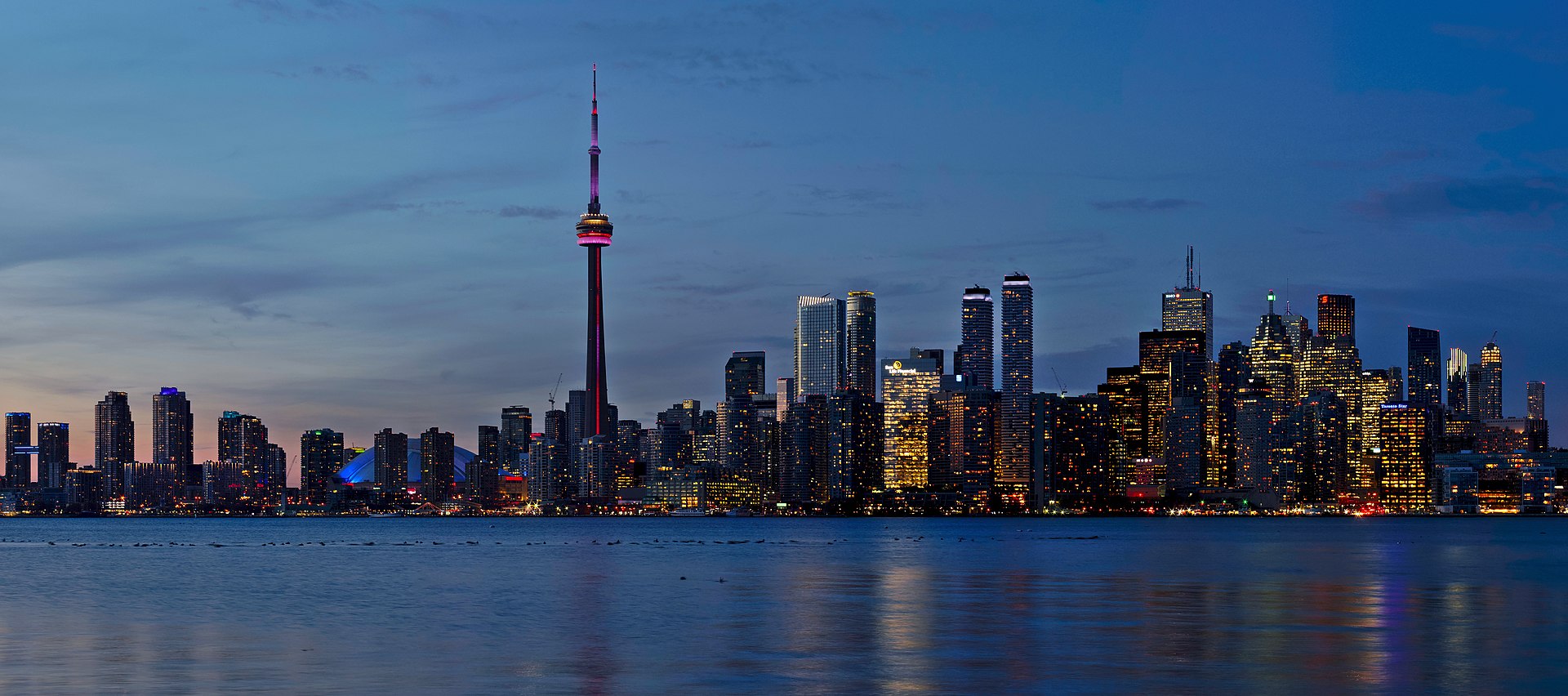
What brings most visitors across the water, though, is the view. From the island shores and the long boardwalk, the downtown skyline rises across the harbour in a single unbroken wall, with the CN Tower spearing above it, a panorama widely regarded as the best in the region.

Bike paths, canoe and kayak rentals, and quiet trails make it easy to spend a whole day, and the crossing itself, with the towers growing behind the ferry's wake, is half the pleasure.

Visiting

The Toronto Islands are reached by ferry from the Jack Layton Ferry Terminal at the foot of Bay Street, with boats running to Centre Island, Ward's Island, and Hanlan's Point; buying ferry tickets online in advance is wise on summer weekends, when lines can be long. The islands are open year round, but most amenities, including Centreville and the rentals, operate seasonally from spring to fall. Bring a bike or rent one on the island to cover the distances easily, and pack food, since options are limited. Allow at least half a day.

Insider tip: Take the ferry over to Ward's Island and walk or cycle west along the boardwalk toward Centre Island: the crowds cluster around the Centre Island dock and amusement park, leaving the eastern boardwalk quiet and delivering the classic skyline view almost to yourself.

📍 View on Google Maps →

Museum · Grange Park / Chinatown · 1900

Art Gallery of Ontario

A great art museum reshaped by a hometown architect, wrapping a curving wall of glass and wood around the largest collection of Canadian art anywhere.

The Art Gallery of Ontario, universally called the AGO, is one of the largest art museums in North America, founded in 1900 and grown over more than a century into a sprawling institution on Dundas Street West at the edge of Chinatown.

Its collection ranges across European masters, contemporary art, African and Oceanic works, and photography, but its deepest strength is Canadian art, held in a collection without rival.

In 2008 the museum reopened after a dramatic transformation by Frank Gehry, who grew up in the surrounding neighbourhood and returned to redesign the building that stands near his childhood home.

His intervention wrapped the Dundas Street facade in a long, billowing curve of glass and Douglas fir and threaded a spiralling wooden staircase up through the galleries, giving the AGO an architectural identity to match its holdings while keeping the historic Grange mansion at its core.

Inside, the galleries hold a celebrated collection of the Group of Seven and Tom Thomson, whose luminous landscapes helped define a national visual identity, alongside works by First Nations, Inuit, and contemporary Canadian artists.

The Thomson Collection brings European masterpieces and a remarkable model ship gallery, and the museum's large collection of Henry Moore sculpture, much of it donated by the artist himself, fills a dedicated light-filled hall.

Visiting

The AGO is open most days, though it typically closes one weekday, so check hours before visiting, and reserving timed tickets online is recommended. It sits on Dundas Street West between the Chinatown and Grange Park areas, reachable by streetcar or a short walk from the St. Patrick subway station. Certain evening hours may offer free or reduced admission, worth confirming in advance. Plan at least two hours for the highlights, and do not miss Gehry's spiral staircase and the Canadian galleries, which are the collection's true heart.

Insider tip: Climb Gehry's spiral wooden staircase up through the galleries and out to the north-facing curve of windows: the sculptural stair is a work of art in itself, and the view it frames over the neighbourhood is one many visitors overlook while hunting for the paintings.

📍 View on Google Maps →

Frequently Asked Questions

What are the best landmarks to see if I only have limited time in Toronto?

Prioritize the downtown core: the CN Tower and Ripley's Aquarium in the entertainment district, then Union Station and the Financial District towers. Walk north to Nathan Phillips Square for Toronto City Hall and the old City Hall clock tower, and cast an eye toward the St. Lawrence Market.

Which iconic Toronto landmarks are free to visit?

Nathan Phillips Square, the harbourfront parks, and the grounds of Queen's Park are all free, as is entry to St. Lawrence Market and Union Station's Great Hall. View the CN Tower, Old City Hall, and the Distillery District's Victorian lanes from public streets. The Toronto Islands cost only the ferry fare.

How many days do I need to see Toronto's iconic landmarks?

Two full days cover the essentials: one for the CN Tower, the harbourfront, and the Financial District, and another for the museums along Bloor, the Distillery District, and St. Lawrence Market. Three days is ideal, adding Casa Loma, the Toronto Islands, and High Park.

What is the best way to see Toronto's architecture?

Start at Union Station and walk north through the Financial District to Nathan Phillips Square, comparing the 1899 Old City Hall with Viljo Revell's 1965 curved towers. Add the Royal Ontario Museum for Daniel Libeskind's Crystal, the Art Gallery of Ontario for Frank Gehry's redesign, and the Distillery District for restored Victorian industrial brick.

Should I go up to the CN Tower's main LookOut level or the SkyPod for the view?

The main LookOut and Glass Floor at 342 metres cover the classic view of the lake, the islands, and the skyline, with the outdoor SkyTerrace on the same level. The SkyPod climbs to 447 metres for the highest vantage but a smaller window on the crowds. Choose the LookOut for the Glass Floor thrill, the SkyPod for sheer altitude, or EdgeWalk to circle the roof itself.

When is the best time of year to visit Toronto's landmarks?

Late spring through early autumn is prime, with the Toronto Islands ferries running, harbourfront festivals, and patios open across the Distillery District. Summer is liveliest but busiest, so book the CN Tower ahead. Autumn brings thinner crowds and colour in High Park. Winter offers skating at Nathan Phillips Square and warm days inside the ROM and AGO.