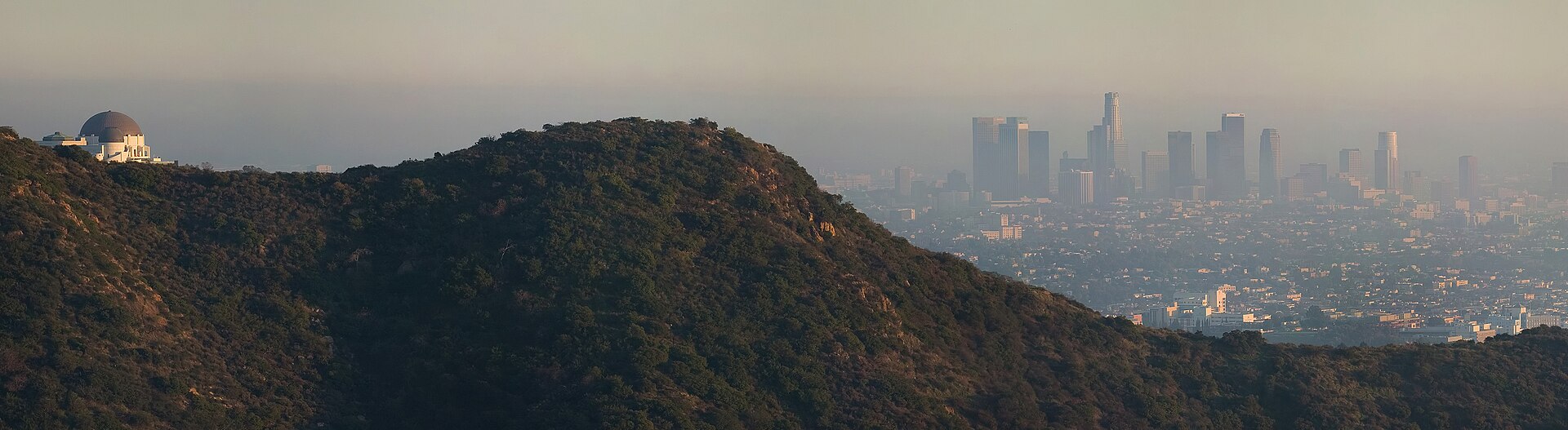
Los Angeles landmarks
Photo: Diliff · CC BY-SA 3.0

Landmarks

Los Angeles's Most Iconic Landmarks

A deep guide to Los Angeles's iconic landmarks: Griffith Observatory, the Getty Center, and Walt Disney Concert Hall, with history and insider visiting tips.

Los Angeles wears its ambitions in stucco, steel, and sunlight.

This is the city that grew from citrus groves and oil derricks into a sprawling metropolis knit together by boulevards, that turned the movie business into a global export, and that scattered its monuments across a basin so wide you read it by neighborhood rather than by a single downtown core.

To move through its streets is to travel through a century of reinvention, where a 1920s Art Deco pier faces the Pacific, a hilltop observatory crowns a wild urban park, and a billowing skin of stainless steel bends the afternoon light into music.

What makes Los Angeles's landmarks so compelling is that they refuse to sit in one place. They climb the Hollywood Hills, ring the Civic Center, line the shore from Santa Monica to San Pedro, and hide in plain sight along Wilshire Boulevard's Miracle Mile.

The buildings converse across freeways rather than a river, the public art invites you to walk right up to it, and the museums hold collections that rival anything on either coast.

The mountains, the ocean, and that famous light tie it all together and give the city its restless, cinematic mood.

This guide gathers eleven landmarks that define Los Angeles: the hilltop icons, the beloved works of civic architecture, the world-class museums, and the folk masterpiece in Watts that one man built by hand over thirty-three years.

For each you will find what it is, why it matters, what to look for, and how to visit sensibly. Read it front to back for an architectural narrative of the city, or skip to the places that call to you and build your own route across the hills, downtown, and the coast.

Observatory · Los Feliz / Griffith Park · 1935

Griffith Observatory

A gleaming Art Deco temple to the sky on the slope of Mount Hollywood, where the whole basin glitters below and the stars wheel overhead.

Griffith Observatory sits on the southern flank of Mount Hollywood in Griffith Park, a copper-domed Art Deco landmark that has drawn Angelenos and visitors up its winding road since 1935. It was funded by the mining magnate Griffith J.

Griffith, who deeded the surrounding land to the city and left money to build a public observatory, insisting that looking through a telescope should be free to all. That founding idea still holds: admission to the building and its telescopes costs nothing.

Inside, the observatory is part science museum and part civic monument.

A Foucault pendulum swings in the central rotunda beneath murals of the heavens, a Tesla coil crackles in the Hall of Science, and the Samuel Oschin Planetarium runs live shows beneath one of the finest domes in the country.

After dark, staff wheel out the historic Zeiss refracting telescope on the roof, and it is said that more people have looked through it than any other telescope on Earth.

The building is as famous for what surrounds it as for what it holds. Its terraces command a sweeping panorama of the Los Angeles basin, the downtown towers, and the Pacific on a clear day, while the Hollywood Sign stands in plain view on the ridge to the west.

Film lovers know the grounds from Rebel Without a Cause, which is commemorated with a bust of James Dean, and more recently from La La Land. It is the rare place that satisfies stargazers, hikers, architecture buffs, and sunset seekers all at once.

Visiting

The observatory is open most days but closed on Mondays, with free admission to the grounds and building, though planetarium shows carry a modest ticket price. Parking on the hill is limited and fills quickly on weekends, so arrive early, take a rideshare, or use the DASH Observatory shuttle from the Vermont/Sunset Metro station. Many trails also lead up on foot for those who want the climb. Come toward late afternoon to enjoy daylight views, the sunset, and the city lights, and check the schedule for public telescope nights.

Insider tip: Time your visit so you are on the west-facing lawn at dusk: you can watch the sun drop toward the Pacific, see the Hollywood Sign catch the last light, and stay as the entire grid of the city switches on beneath you.

📍 View on Google Maps →

Landmark · Hollywood Hills / Mount Lee · 1923

Hollywood Sign

Nine towering white letters on a mountainside that became the world's shorthand for fame, fortune, and the movies.

The Hollywood Sign runs across the south face of Mount Lee, high above the neighborhood that shares its name, spelling out fifty-foot letters that are recognized around the globe.

It began life in 1923 not as a civic emblem but as an advertisement, reading HOLLYWOODLAND to promote a hilltop housing development, complete with thousands of light bulbs that once flashed the name in segments across the night.

The LAND was dropped in the late 1940s when the sign, by then dilapidated, was repaired and adopted as a symbol of the entire district.

By the 1970s the letters had again decayed into a sagging ruin, and a public campaign, backed by donors including Hugh Hefner and the rock star Alice Cooper, funded a complete rebuild in 1978, giving the sign the sturdy steel letters that stand today.

The sign is meant to be seen rather than touched: it is fenced, alarmed, and off limits up close, but the whole point is the view of it from below and afar.

It presides over the city as a piece of pure iconography, endlessly photographed, a marker that tells you instantly where you are.

Reaching a good vantage point becomes a small urban hike through the canyons and ridgelines of the Hollywood Hills, rewarding the effort with the letters framed against the chaparral.

Visiting

There is no admission and no way to stand at the letters themselves, so the experience is about finding the best viewpoint. Popular options include the trails of Griffith Park, especially the hike up toward the summit of Mount Lee behind the sign, the overlook at the top of Beachwood Canyon, and the Lake Hollywood Park lawn for an easy roadside look. Bring water, sun protection, and sturdy shoes for the longer trails, and note that residential streets nearby have strict parking limits. Morning offers cooler air and clearer skies.

Insider tip: For the closest legal view, hike the fire road to the summit of Mount Lee: you end up standing directly above the letters with the whole San Fernando Valley on one side and the city on the other, a far better payoff than the crowded roadside pullouts.

📍 View on Google Maps →

Concert Hall · Downtown / Bunker Hill · 2003

Walt Disney Concert Hall

A billowing sculpture of stainless steel sails that houses one of the most acoustically perfect rooms in the world.

Walt Disney Concert Hall crowns Bunker Hill in downtown Los Angeles, a swirl of curving stainless steel designed by Frank Gehry and opened in 2003 as the home of the Los Angeles Philharmonic.

Its exterior of shimmering metal petals seems to be caught mid-motion, a piece of frozen music that has become one of the defining images of contemporary Los Angeles and a landmark of twenty-first century architecture.

Behind the dramatic skin lies a room built for sound above all else. Gehry worked with the acoustician Yasuhisa Toyota to shape a warm, enveloping vineyard-style auditorium, where the audience surrounds the orchestra on all sides beneath a sail-like ceiling of Douglas fir.

At the heart of the stage stands a striking pipe organ whose curving wooden pipes, nicknamed the french fries, have become an emblem in their own right.

The hall anchors a stretch of Grand Avenue that has become the city's cultural spine, steps from The Broad and the Museum of Contemporary Art.

Its public gardens climb the exterior with a hidden rose-shaped fountain tiled in broken Delft porcelain, and the building rewards a slow walk around its base even without a ticket.

Together with its neighbors, it has helped turn a once-sleepy downtown into a genuine destination for music, art, and design.

Visiting

The concert season runs roughly from autumn through spring, and tickets for Los Angeles Philharmonic performances sell out quickly for marquee programs, so book ahead. Even without a concert, the exterior gardens and terraces are open to the public during the day at no charge, and free self-guided audio tours of the building are often available on non-matinee days. The hall sits atop Bunker Hill, easily reached by Metro to the Civic Center or Grand Avenue Arts stations, with paid parking beneath the building.

Insider tip: Walk up the outdoor stairway on the north side to find the Blue Ribbon Garden and the hidden mosaic fountain shaped like a rose; most visitors photograph only the steel from the sidewalk and never discover the quiet garden folded into the roof.

📍 View on Google Maps →

Museum · Brentwood · 1997

The Getty Center

A gleaming travertine acropolis on a hilltop, reached by tram, where world-class art meets equally breathtaking gardens and views.

The Getty Center rides a ridge above the 405 freeway in Brentwood, a campus of pavilions clad in rough-cut travertine and white metal designed by Richard Meier and opened in 1997. Funded by the vast endowment of the oil magnate J.

Paul Getty, it is one of the wealthiest arts institutions in the world, and it gives away its greatest asset for free: admission costs nothing.

Visitors leave their cars at the base and ride a driverless tram up the hillside, an ascent that sets the museum apart from the city below and heightens the sense of arrival.

The galleries hold European paintings, drawings, sculpture, and decorative arts, including van Gogh's Irises, works by Rembrandt and Monet, and an outstanding collection of photography and illuminated manuscripts.

The architecture itself is part of the draw, all light stone, open courtyards, and framed vistas.

Beyond the art, the Getty is famous for its setting.

The Central Garden, designed by the artist Robert Irwin as a living work of art, spirals down a ravine through a maze of azaleas and changing plantings, while the terraces offer some of the finest views in Los Angeles, sweeping from the downtown skyline to the ocean.

On a clear day the combination of art, garden, and panorama makes for one of the most rewarding cultural outings in the city.

Visiting

The Getty Center is open most days but closed on Mondays, and admission is free, though parking carries a fee that is reduced in the evening. Reservations are advised at busy times and can be made online before you go. The tram from the parking structure runs continuously and is part of the fun. Allow at least half a day to combine the galleries, the garden, and the views, and consider a late-afternoon visit in summer, when the light softens and the ocean haze often clears.

Insider tip: Do not rush straight into the galleries; walk the outer terraces first and follow the Central Garden path to the bottom of the ravine, then time your loop so you finish on the west terrace as the sun sets over the Pacific.

📍 View on Google Maps →

Historic · Santa Monica · 1909

Santa Monica Pier

A wooden pier reaching into the Pacific, crowned by a solar Ferris wheel and marking the storied end of Route 66.

Santa Monica Pier juts out over the Pacific at the western edge of the city, a wooden boardwalk that has been a seaside gathering place since the original Municipal Pier opened in 1909.

Its neon-lit entrance archway is one of the most photographed sights on the Southern California coast, and the pier famously marks the symbolic western terminus of Route 66, the historic highway that once carried travelers all the way from Chicago.

The pier's heart is Pacific Park, a compact amusement park whose star attraction is the Pacific Wheel, billed as the world's only solar-powered Ferris wheel, glowing after dark with programmable lights above the waves.

Nearby stands the Looff Hippodrome, a National Historic Landmark that shelters a beautifully restored 1922 carousel, its hand-carved horses turning to organ music just as they did a century ago.

Around these landmarks the pier bustles with anglers dropping lines off the end, street performers, an aquarium tucked beneath the deck, and arcades and food stands spilling the smell of funnel cake into the sea air.

It can feel touristy, and it happily embraces that role, but the setting is genuine California magic: the wide beach, the mountains curving north toward Malibu, and the sun sinking straight into the ocean at day's end.

Visiting

The pier is open daily and free to walk, with rides and games at Pacific Park ticketed individually. It is easy to reach by the Metro E Line, which terminates a few blocks away in downtown Santa Monica, a welcome alternative to the pricey and crowded beach parking lots. Come in the late afternoon to stroll the deck, ride the wheel as the light fades, and watch the sunset, then stay for the neon and the lit-up wheel. Weekday visits are far calmer than summer weekends.

Insider tip: Walk out to the very end of the pier past the fishing lines for the best angle back at the Ferris wheel and the mountains behind it; then look for the small Route 66 End of the Trail sign, a favorite photo that most visitors walk right past.

📍 View on Google Maps →

Public Art · Watts · 1954

Watts Towers

A soaring folk-art dreamscape of steel and mosaic, built by one determined man over thirty-three years with his bare hands.

The Watts Towers rise unexpectedly from a residential triangle in the Watts neighborhood of South Los Angeles, a cluster of slender openwork spires that the Italian immigrant tile-setter Simon Rodia built entirely by himself between 1921 and 1954.

He called his creation Nuestro Pueblo, our town, and worked without machines, scaffolding, bolts, or a single formal plan, bending and wiring steel rods by hand and coating them in mortar.

Rodia then encrusted every surface with a glittering mosaic of found materials: broken pottery, seashells, colored glass from soda and medicine bottles, tile fragments, and pieces of pressed-glass dishware, all pressed into the wet cement.

The tallest of the towers reaches nearly one hundred feet, an astonishing height for a mortared structure raised without heavy equipment, and the whole complex is a masterwork of self-taught vision and sheer persistence.

When Rodia finished in his seventies, he simply deeded the property to a neighbor and left, never to return.

The towers were later threatened with demolition and famously survived a city stress test that failed to pull them down, proving the strength of his intuitive engineering.

Today they are recognized as a National Historic Landmark and one of the great works of American folk art, a monument to what one person can build out of belief and cast-off fragments.

Visiting

The towers stand within a protective fence and are viewed on guided tours, which run on select days, typically Thursday through Sunday, for a small fee, while the adjacent Watts Towers Arts Center and its exhibitions are free. It is best reached by the Metro A Line to the 103rd Street/Watts Towers station, just a short walk away. Tours can be limited or paused for conservation work, so check the current schedule before setting out, and allow time to visit the arts center and its community gallery.

Insider tip: Go on a bright, clear morning and take the guided tour: sunlight is what brings the mosaics alive, igniting the embedded glass and pottery into color, an effect that is muted on gray days and lost entirely from behind the fence.

📍 View on Google Maps →

Historic · Downtown · 1939

Union Station

The last of America's great railway stations, a sunlit marriage of Spanish mission romance and streamlined Art Deco cool.

Los Angeles Union Station opened in 1939 on the edge of downtown, near the old pueblo where the city was born, and is often called the last of the great American railway stations.

Designed principally by the father-and-son architects John and Donald Parkinson, it blends Spanish Colonial and Mission Revival forms with the clean geometry of Art Deco and Streamline Moderne, a combination that could only have come from Southern California.

The soaring main waiting hall is the building's glory: a coffered wood ceiling floats high above travertine walls and a floor patterned in marble and terracotta, while enormous arched windows pour golden light across rows of original high-backed leather-and-wood seats.

Shaded garden patios flank the concourse, planted with palms and fountains, so that even the act of waiting for a train feels like a stroll through a courtyard.

Once nearly forgotten in the age of the automobile, the station has been reborn as the hub of the region's expanding rail network, serving Amtrak, Metrolink commuter trains, and several Metro subway and light-rail lines.

Its unmistakable interiors have appeared in countless films, and a visit rewards anyone who steps inside simply to admire it, whether or not they are catching a train. It stands across from Olvera Street and the historic plaza, tying the modern city back to its origins.

Visiting

Union Station is a working transit hub, open daily and free to enter and explore, and it is itself the easiest way to arrive, served by the Metro B and D subway lines and multiple bus and rail connections. Wander the main waiting room, the ticket concourse, and the garden patios, all accessible to the public. Midday brings the most dramatic light through the great windows, while early mornings and late evenings are quietest. Pair a visit with nearby Olvera Street and the Chinatown gateway just to the north.

Insider tip: Step into the original waiting hall and sit for a few minutes in one of the vintage leather chairs beneath the towering windows; the light, the scale, and the hush make it one of the most cinematic free rooms in the city, and it is often nearly empty between train rushes.

📍 View on Google Maps →

Museum · Miracle Mile · 1965

LACMA and Urban Light

The largest art museum in the West, fronted by a glowing forest of vintage street lamps that has become the city's favorite selfie.

The Los Angeles County Museum of Art, universally known as LACMA, spreads across a campus on Wilshire Boulevard's Miracle Mile and is the largest art museum in the western United States.

Founded as an independent institution in 1961, it holds an encyclopedic collection of nearly a hundred and fifty thousand works spanning ancient times to the present, with особенно strong holdings in Latin American, Asian, Islamic, and modern and contemporary art.

Its most beloved landmark needs no ticket at all.

Urban Light, an installation by the artist Chris Burden unveiled in 2008, arranges more than two hundred restored cast-iron street lamps, salvaged from across Southern California and painted a uniform gray, into a dense colonnade at the museum's entrance.

By day it is a sculpture of repeated forms, and after dusk it lights up into a glowing grove that has become one of the most photographed spots in Los Angeles.

Nearby sits another outdoor showstopper, Levitated Mass, a three-hundred-ton granite boulder that appears to hover over a walkway cut into the ground, the work of the land artist Michael Heizer.

The museum is currently in the midst of a sweeping transformation, replacing several older buildings with a sinuous new gallery designed by Peter Zumthor, so the campus itself is a work in progress.

Across the street, the La Brea Tar Pits bubble with prehistoric asphalt, making this a rich cultural corner of the city.

Visiting

LACMA is open most days but closed on Wednesdays, with hours that run late on some evenings, and timed tickets are recommended, though Urban Light and the outdoor art are always free to visit. It is reachable by bus along Wilshire and, increasingly, by the extending Metro D Line subway. Because parts of the campus are under construction, check which galleries are open before you go. Come at dusk to catch Urban Light glowing against the darkening sky, the ideal moment for a photograph.

Insider tip: Arrive just as the sky turns deep blue after sunset and walk into the middle of Urban Light: standing inside the lamps rather than photographing them from the sidewalk gives the immersive, glowing shot that everyone remembers, and the crowds thin once full night sets in.

📍 View on Google Maps →

Historic · Hollywood · 1927

TCL Chinese Theatre

A flamboyant movie palace where the world's biggest stars have pressed their hands and feet into the wet cement of the forecourt.

The TCL Chinese Theatre, still known to many as Grauman's Chinese, presides over Hollywood Boulevard with a soaring pagoda facade of red columns, ornate ironwork, and a giant stone dragon, an exuberant fantasy of the Far East as imagined in the 1920s.

The showman Sid Grauman opened it in 1927 with the premiere of Cecil B. DeMille's The King of Kings, and it has been one of the most famous cinemas on Earth ever since.

Its legend rests on the forecourt, where nearly two hundred film stars have left their handprints, footprints, and signatures in blocks of concrete, a tradition that, by studio lore, began by accident when a star stepped into wet cement.

Visitors wander freely among the slabs, matching their own hands to those of icons from the silent era to the present, and some celebrities added quirks: a set of Groucho Marx's cigar, the hoofprints of Roy Rogers' horse, and the profiles of well-known noses.

The theater remains a working cinema, home to red-carpet premieres and one of the largest IMAX screens in the world behind its historic walls.

It anchors the busy stretch of Hollywood Boulevard where the Walk of Fame's brass stars run along the sidewalks, a district that is loud, crowded, and unapologetically touristy, yet still crackles with the mythology of the movies that built the city's name.

Visiting

The forecourt with its celebrity prints is open to the public at all hours and free to explore, while seeing a film inside means buying a ticket to a current release, often a blockbuster on the big IMAX screen. Guided tours of the historic auditorium are also offered for a fee. The theater sits directly above the Hollywood/Highland Metro B Line station, by far the easiest way to arrive given the traffic and pricey parking. Expect dense crowds and costumed characters on the sidewalk, especially in the afternoon.

Insider tip: Come early in the morning before the tour buses arrive if you want to actually read the forecourt slabs and photograph them; by midday the concrete is elbow to elbow, and the quiet early hour lets you hunt for your favorite stars in peace.

📍 View on Google Maps →

Historic · Downtown · 1893

Bradbury Building

A plain brick exterior hiding a breathtaking sunlit atrium of wrought iron, marble, and open-cage elevators.

The Bradbury Building stands on Broadway in downtown Los Angeles, and from the street it gives almost nothing away: a modest five-story block of brown brick and sandstone that most passersby would never look at twice.

Step through the doors, however, and it opens into one of the most astonishing interiors in America, a soaring central court flooded with light from a vast glazed roof overhead.

Commissioned by the mining millionaire Lewis Bradbury and completed in 1893, the building was designed largely by George Wyman, a young draftsman with no formal architectural training who, by legend, accepted the job after consulting a Ouija board.

The court he created rises through open galleries wrapped in intricate wrought iron, some of it imported from France, with polished marble stairs, glazed brick, and richly grained wood, all bathed in the golden daylight pouring down from above.

The two open-cage elevators still glide up and down as they did over a century ago, and the interplay of ironwork, shadow, and light has made the atrium irresistible to filmmakers, most famously as a haunting setting in Blade Runner.

It remains an occupied office building rather than a museum, so public access is limited to the lobby and the first landing, but even that glimpse is enough to see why it is treasured as the finest surviving example of its kind in the city.

Visiting

The Bradbury Building is a working office building, so visitors are welcome only in the ground-floor lobby and up to the first-floor landing, free of charge, during posted daytime hours on most days. Photography of the atrium from these areas is permitted, but the upper galleries are private. It sits in the heart of downtown, easily reached on foot from the Metro Pershing Square station, and pairs well with the historic Grand Central Market directly across the street. Midday light is when the glass roof works its magic.

Insider tip: Go around noon on a sunny day, when the sun is highest and the great skylight floods the atrium with warm light off the ironwork; then cross the street to Grand Central Market for lunch, turning a five-minute marvel into a proper downtown outing.

📍 View on Google Maps →

Museum · Downtown / Bunker Hill · 2015

The Broad

A honeycombed white veil wrapping a free museum of contemporary art, home to hypnotic Infinity Mirror Rooms.

The Broad opened in 2015 on Grand Avenue in downtown Los Angeles, a contemporary art museum founded by the philanthropists Eli and Edythe Broad to house their remarkable collection and share it with the public for free.

Designed by the firm Diller Scofidio and Renfro, the building is wrapped in a porous white concrete lattice the architects call the veil, which filters daylight into the top-floor galleries.

At its core sits the vault, the opaque concrete mass that stores the collection's overflow and whose sculpted underside shapes the visitor's path.

A tunnel-like escalator bores straight up through it to deposit you in the sky-lit galleries above, a piece of theater that makes the act of moving through the building part of the experience.

Inside hang works by Jean-Michel Basquiat, Andy Warhol, Roy Lichtenstein, Cindy Sherman, Jeff Koons, and other leading names in postwar and contemporary art.

The museum's most sought-after draws are the Infinity Mirrored Rooms by the Japanese artist Yayoi Kusama, small chambers lined with mirrors and lights that dissolve into a seemingly endless glittering void, entered one visitor or group at a time.

Together with the neighboring Walt Disney Concert Hall and MOCA, The Broad has helped cement Grand Avenue as the cultural core of a revitalized downtown, drawing crowds to an area that not long ago emptied out after dark.

Visiting

The Broad is open most days but closed on Mondays, and general admission is free, though it is wise to reserve a timed entry online in advance because the free tickets go quickly. Special exhibitions and, at times, the Infinity Rooms may require separate reservations. It sits atop Bunker Hill, easily reached by the Metro to the Grand Avenue Arts or Civic Center stations, with paid parking beneath the building. Weekday visits and same-day standby lines are options if timed tickets are gone.

Insider tip: Book the earliest free slot of the day and head straight for the Yayoi Kusama Infinity Mirrored Room before the line builds; the wait for those few private seconds inside can stretch to an hour by afternoon, but is nearly walk-on right at opening.

📍 View on Google Maps →

Frequently Asked Questions

What are the best landmarks to see if I only have limited time in Los Angeles?

Prioritize two clusters. Downtown gives you Walt Disney Concert Hall, The Broad, Grand Central Market, and Union Station within walking distance. Then head to Griffith Observatory for the skyline, the Hollywood Sign view, and the planetarium at dusk.

Which iconic Los Angeles landmarks are free to visit?

Griffith Observatory, the Getty Center, and the Getty Villa all offer free admission, though the Getty sites charge for parking. Watts Towers grounds, Grand Central Market, and the exterior of Walt Disney Concert Hall cost nothing. Santa Monica Pier entry is free; rides cost extra.

How many days do I need to see Los Angeles's iconic landmarks?

Two full days cover the essentials: one for Downtown's Music Center, The Broad, and Union Station, and another for Griffith Observatory, Hollywood, and the Getty Center. Three days is ideal, adding LACMA, the Santa Monica Pier, and Watts Towers.

What is the best way to see Los Angeles's architecture?

Build a route rather than take a single cruise, since the city is spread out. Pair Downtown's Bradbury Building, Union Station, and Walt Disney Concert Hall with a drive to the Getty Center, then add Griffith Observatory for its 1935 Art Deco and citywide panorama.

Should I go up Griffith Observatory or the OUE Skyspace for the view?

Griffith Observatory is free, sits high in the hills, and frames the Hollywood Sign, the basin, and the ocean, best at sunset. OUE Skyspace atop the U.S. Bank Tower is the tallest open-air deck downtown and has the Skyslide. Choose Griffith for atmosphere, Skyspace for altitude.

When is the best time of year to visit Los Angeles's landmarks?

Spring and autumn are prime, with mild temperatures, clear light, and thinner crowds than summer. Summer is liveliest at the beaches and pier but hazier inland, so start early. Winter is quiet and often bright after rain, ideal for the hilltop observatories and museum days.